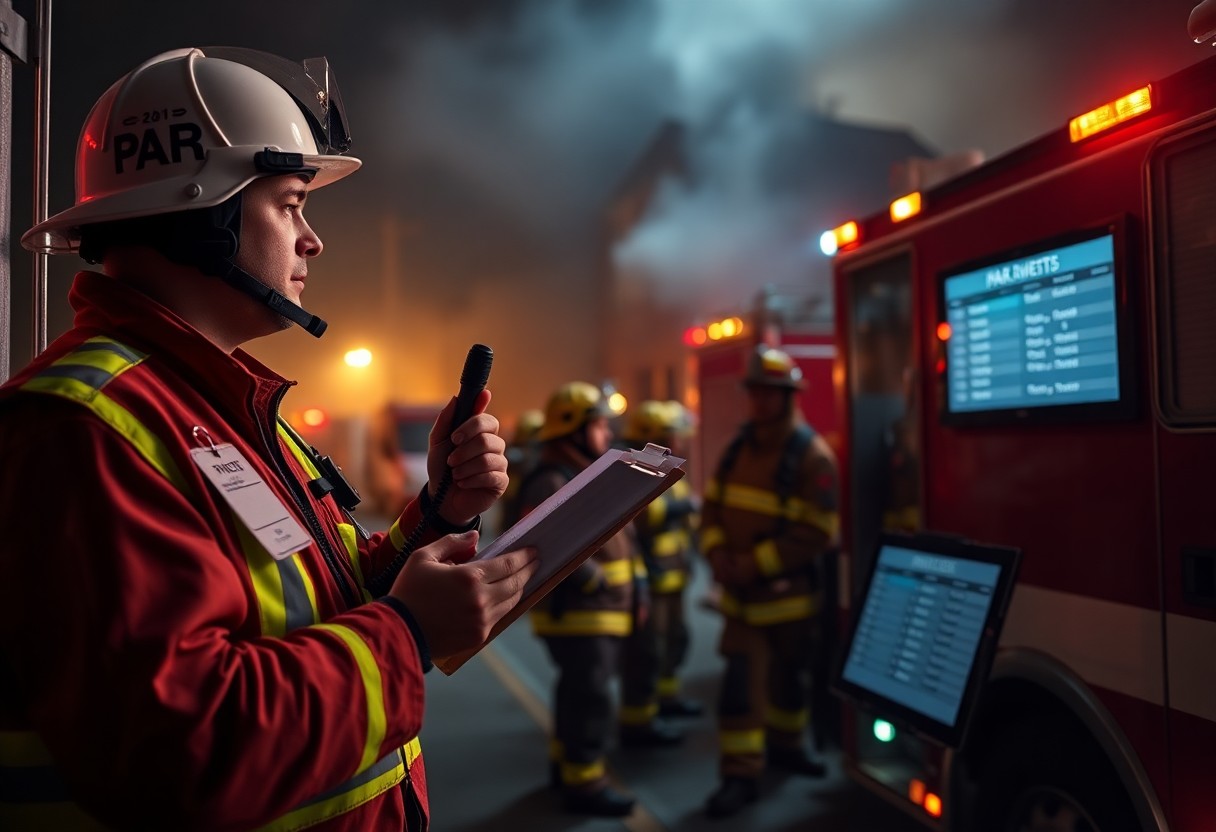
Overseeing incident command, you coordinate officers to conduct systematic PAR checks, maintain accountability, enforce safety zones, and direct resources so crews operate predictably and hazards are minimized during operations.
The Fundamentals of Personnel Accountability Reports (PAR)
PAR gives you a snapshot of who is on scene and safe, ensuring accountability during dynamic incidents. You use scheduled and event-driven PARs to verify assignments, track crew locations, and trigger rapid response if someone is missing.
Defining the Purpose and Frequency of PAR Checks
You schedule PAR checks at regular intervals and after critical actions to confirm assignments, update status, and guide tactical decisions. You also initiate unscheduled PARs when conditions change or communications fail.
Identifying Critical Benchmarks for Accountability
Benchmarks include crew accountability, last known locations, SCBA air status, and completion of assigned tasks; you use these measures to determine withdrawal, reassignment, or RIT activation.
Assessing benchmarks requires you to confirm crew counts, team integrity, SCBA cylinder pressure, and time-stamped task progress. You track last known locations, communications status, and exposure to collapse or flashover indicators. You act on any discrepancy by declaring a mayday, ordering immediate PAR repeats, or directing RIT deployment to resolve the issue.
The Incident Commander’s Strategic Oversight
As incident commander, you set strategy, prioritize scene safety, and initiate PAR checks to confirm crew status and accountability while adjusting tactics to emerging hazards.
Establishing the Accountability Framework
You define role assignments, risk thresholds, and reporting cadence so crews know when to conduct PAR checks and what information to report during evolving operations.
Managing Resource Tracking and Entry Control
Teams operating inside require your strict tracking and established entry control points so you can confirm who is inside and manage rapid PAR checks.
Effective entry control combines physical accountability tags, a staffed control point, and a visible roster so you can track assignments in real time. Use time-stamped check-ins, dedicated accountability officers, and concise radio shorthand to accelerate PAR checks. Maintain a designated rescue team staging area and enforce immediate reporting procedures to reduce delay when you must confirm, withdraw, or task crews.
Tactical Supervision by Company Officers
Company officers direct PAR checks and scene safety by assigning tasks, monitoring radio traffic, and enforcing accountability so you maintain control during dynamic operations.
Maintaining Crew Integrity on the Fireground
You must enforce crew accountability, keep your teams together, and limit off-task movement so PAR checks reflect true crew status and you reduce risk during interior operations.
Real-Time Reporting and Situational Awareness
Your timely radio updates and status tags keep you and command informed so PAR checks occur with current information and hazards are addressed quickly.
Make regular, concise radio reports of location, air supply, and observed hazards so you provide command the data to prioritize rescues, adjust sector boundaries, and verify PAR accuracy as conditions change.
The Safety Officer’s Role in Risk Mitigation
Safety officers evaluate hazards, set controls, and direct PAR procedures so you maintain accountability and minimize exposure during dynamic incidents.
Monitoring Fireground Hazards and Conditions
Watch for changes in smoke, heat, structural integrity, and hazardous materials; you relay observations and trigger scene adjustments to protect crews and bystanders.
Validating PAR Accuracy during High-Risk Operations
Confirm PARs by cross-checking crew rosters, timestamps, and radio traffic so you can rapidly identify missing members and initiate rescue or reassignment.
During high-risk operations assign a dedicated accountability officer, schedule frequent PAR intervals, and use redundant communications plus staging points so you verify each crew’s exact location and status before permitting further action.
Communication Protocols for Seamless Coordination
You depend on clear communication protocols-defined briefings, role call cadence, and confirmation loops-to coordinate PAR checks, speed accountability, and reduce confusion at complex scenes.
Radio Discipline and Standardized Terminology
Your team must enforce radio discipline and standardized terminology so transmissions stay concise, status reports are consistent, and PAR exchanges remain immediately actionable.
Technology Integration in Modern Accountability Systems
Ensure you integrate electronic accountability tags, GPS tracking, and incident-management platforms to log PARs in real time and visualize unit locations.
Adopt interoperable tools that sync with dispatch and ICS, set alert thresholds for missed PARs, train crews on device protocols, and maintain manual backup procedures; this lets you verify assignments, monitor movement, and trigger rapid intervention when status anomalies appear.
Training and Drills for Leadership Readiness
Training scenarios build your decision-making for PAR checks and scene safety, reinforcing clear command roles, rapid accountability, and predictable crew responses under pressure.
Simulation-Based Accountability Exercises
Simulations force you to run timed PARs, test communication paths, and correct identification errors so accountability becomes immediate and verifiable.
Instilling a Culture of Proactive Scene Safety
Leadership sets expectations so you consistently scan hazards, assign safety officers, and prioritize withdrawal when conditions exceed crew capabilities.
You instill proactive safety by setting clear expectations, modeling hazard recognition, and granting safety officers authority to pause operations. You reinforce quick PAR discipline through regular mentoring, hands-on coaching, and candid after-action reviews, making safe decisions habitual. You give clear recognition for crews who stop unsafe actions and apply firm corrective steps for lapses to keep standards consistent.
Final Words
With these considerations, you understand that fire department leaders set clear accountability, assign and verify PAR checks, enforce safety protocols, maintain scene-wide communication, and adjust tactics based on hazard assessments to protect crews and sustain operational control.
FAQ
Q: What responsibilities does the incident commander have for PAR checks and overall scene safety?
A: The incident commander establishes command, assigns accountability roles, and sets expectations for PAR checks immediately upon arrival. They order PAR checks at defined triggers such as a change from offensive to defensive tactics, reports of missing firefighters, structural collapse, a declared mayday, or transfer of command. The commander ensures a designated accountability officer or division/group supervisors collect and report PAR results, maintains clear radio channels for those reports, and uses PAR data to guide tactical decisions like withdrawal or resource allocation. The commander enforces scene safety measures by appointing a safety officer, managing risk-versus-gain decisions, and initiating evacuation or emergency procedures when PARs indicate personnel at risk.
Q: How do company officers and crew leaders conduct PAR checks and maintain crew safety on the fireground?
A: Company officers maintain positive crew accountability by tracking assignments, locations, and air supply status, then reporting that information to command during requested PARs. They perform face-to-face roll calls, use company passports or tag systems, and verify the presence and condition of each crew member before and after tasks such as entering a structure or performing a search. Company officers enforce radio discipline and immediate reporting of low air, entrapment, or injury so command receives accurate PAR information. Crew leaders also manage crew rotations, rehab, and hazard mitigation to reduce situations that will trigger emergency PARs.
Q: What policies, tools, and training do leaders implement to support timely PAR checks and improve scene safety?
A: Departments adopt standard operating procedures that define PAR triggers, reporting formats, and assigned accountability roles, and they integrate those procedures into incident action plans. Leaders equip crews with accountability tools such as passports, tagboards, electronic accountability systems, and clearly marked staging for personnel tracking, and they maintain redundant methods in case technology fails. Training programs include regular drills on mayday response, rapid intervention team activation, PAR reporting under stress, and hands-on accountability exercises during realistic scenarios. Leaders conduct after-action reviews to correct procedural gaps, update SOPs, and reinforce a culture of immediate, accurate PAR reporting to sustain firefighter safety.