Safety depends on precise PAR reporting; you must standardize procedures, train crews in concise status checks, use simple confirmation protocols, and audit reports regularly so you can reduce confusion, speed rescues, and maintain accountable, predictable operations.
The Strategic Importance of PAR in Fireground Safety
PAR gives you a clear snapshot of crew locations and status during operations, enabling quicker risk assessments and targeted crew assignments to reduce exposure and speed rescues.
Defining the Personnel Accountability Report
Personnel Accountability Report lets you confirm who is assigned, where they operate, and when they’re accounted for, simplifying roll calls and change-of-condition tracking.
Impact on Incident Command Decision-Making
Command relies on PAR to make timely decisions about resource deployment, risk tolerance, and withdrawal, so you can adjust tactics with verified crew status.
When you integrate PAR updates with staging, rapid intervention crews, and mission assignments, you shorten decision cycles and reduce guesswork during escalating incidents. You maintain safer risk profiles by prioritizing crews for relief or withdrawal based on verified positions, enabling measured tactical shifts and clearer communication between command and companies.
Standardizing Radio Discipline and Terminology
Standardizing your radio discipline and shared terminology ensures you call PARs with consistent cues and reduces misinterpretation during incident shifts.
Implementing Clear Text Communication
Use plain, standardized phrasing for PARs so you convey location, status, and counts without ambiguity, shortening transmission time and easing team response.
Reducing Airtime Congestion During Critical Updates
Limit transmissions to concise PAR vitals, assign a single channel owner, and require brevity responses so you prevent overlapping updates during high-tempo incidents.
Assign a dedicated channel manager so you can queue nonurgent traffic, enforce one-sender-at-a-time rules, stagger team check-ins, and use short confirmation codes to keep critical PARs audible and actionable.
Optimizing Benchmarks for PAR Initiation
Set benchmarks based on entry type and risk level so you can trigger PAR checks only when needed, reducing false alerts and maintaining readiness.
Event-Driven vs. Time-Driven Reporting
Compare event-driven PARs that react to triggers with time-driven checks you schedule, and choose configurations that fit your crew rhythms and mission tempo to minimize disruptions while preserving safety.
Managing Accountability During Mayday Situations
Assign clear PAR leads so you know who conducts sweeps and reports status during a mayday, shortening response time and reducing confusion.
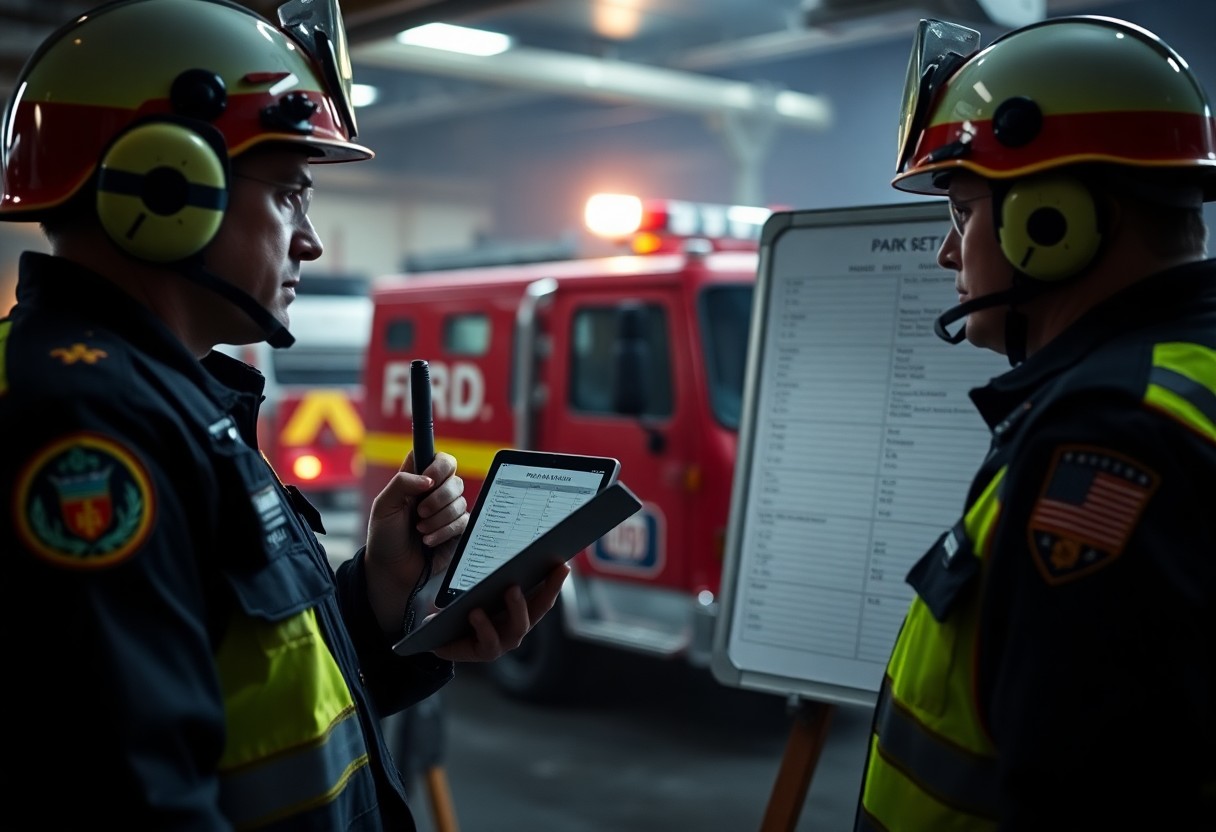
During a mayday, you establish a single PAR leader who coordinates entry and egress tracking, assigns sweep teams, and maintains the accountability log. Make radio calls concise, confirm names and last-known positions, and require verbal confirmation before marking personnel cleared. Include a visible status board you update live so command and crews can prioritize searches. Train crews on rapid role shifts, confirmation scripts, and how to cross-check tags or thermal/locator readings to avoid false clears.
Integrating Advanced Tracking Technologies
Chiefs can integrate GPS, AIS, geofencing, and RFID to tighten PAR accuracy and reduce search time, ensuring you maintain continuous crew visibility during complex evolutions.
- Enable GPS and AIS feeds to stream live positions to command.
- Deploy wearable tags for individual tracking and rapid detection.
- Hook telemetry into dashboards for instant, auditable PAR updates.
Technology vs Benefit
| Technology | Benefit |
|---|---|
| GPS / AIS | Live positioning to pinpoint crews |
| Wearable tags | Individual accountability and faster retrieval |
| Telemetry dashboards | Auditable, real-time PAR and alerts |
Digital Accountability Systems and Telemetry
Telemetry systems stream location, status, and vitals so you can track each person in real time and trigger alerts when anomalies appear.
Transitioning from Manual Boards to Real-Time Data
Switching from whiteboards to live dashboards gives you instant, auditable PAR updates and reduces human error during high-tempo incidents.
When you map existing PAR routines, identify failure points, then phase in tags, fixed receivers, and dashboard feeds that push live counts to incident command. Train crews on device checks and run drills that compare board readings to telemetry; adjust alarm thresholds and SOPs until automated reporting matches operational needs.
Training for High-Stress Accountability
You run high-stress PAR training that simulates real incident pressure, forcing quick location checks, concise radio reports, and stress-tested leadership decisions so you build reliable habits for rapid accountability.
Incorporating PAR into Multi-Company Drills
Captains include multi-company PARs in joint drills, assigning reporting order, shared channels, and a common verification method so you practice coordinated accountability under complex command.
Identifying and Correcting Common Reporting Errors
Leaders train crews to detect duplicate reports, incorrect unit IDs, and missed status updates, then run corrections exercises so you eliminate tracking errors before they affect operational decisions.
Errors often stem from rushed radios, inconsistent unit naming, and gaps in confirmation; you should standardize radio scripts, enforce read-backs, and schedule targeted drills with deliberate error insertion to make corrections instinctive and reduce miscounts on scene.
Fostering a Culture of Compliance and Precision
You set clear expectations, conduct regular audits, and run ongoing training so crew follow precise PAR reporting routines; promote honest error reporting and positive reinforcement to keep compliance high and operations safer.
The Captain’s Role in Crew Verification
As captain, you confirm identities before departure, cross-check manifests against live headcounts, and insist on immediate PAR updates after any movement so you close reporting gaps quickly.
Chief-Level Oversight and Post-Incident Analysis
When overseeing incidents, you standardize debrief templates, review timestamp accuracy, and require root-cause notes so lessons feed back into procedures and reduce repeat failures.
Ensure you schedule audits, run simulated drills, and perform data integrity checks; require chiefs to analyze PAR timelines, correlate GPS and radio logs, and produce corrective action plans. Mandate transparent near-miss reporting, track fix implementation, and publish concise after-action summaries so crews see improvement and adopt consistent, reliable reporting practices.
Conclusion
On the whole you improve safety by standardizing PAR reports, enforcing regular drills, training crews on accurate entries, and reviewing incidents promptly; you audit compliance, mentor teams, and act decisively on findings to reduce exposure and prevent recurring hazards.
FAQ
Q: What immediate actions can chiefs and captains take to improve PAR reporting accuracy during an incident?
A: Chiefs and captains should assign a dedicated PAR officer as soon as command is established to collect and announce accountability. Use a standardized PAR script and short, repeatable radio phrases so reports are consistent and easy to audit. Maintain a visible physical accountability board or roster at the command post and pair it with a quick tag system (helmet, wristband, or RFID) at entry and exit points. Require face-to-face confirmation for crew transfers or rotations and mandate read-backs for every PAR announcement to catch misheard names or numbers. Log time-stamped PAR events and immediately run a focused re-PAR after any personnel movement, MAYDAY, or team withdrawal. Enforce commander-level oversight: chiefs and captains must intervene on the first sign of conflicting reports or missing personnel instead of waiting for routine intervals.
Q: How should communication protocols and technology be organized to speed PAR reporting without creating confusion?
A: Designate a single radio channel or talk group for PAR traffic and restrict PAR transmissions to the assigned PAR officer and incident commander to reduce clutter. Standardize phraseology and short-form templates that state crew ID, location, and status, then require quick read-back confirmation. Adopt a primary digital PAR tool with offline capability and a parallel paper backup so accounting continues if devices fail. Implement simple physical aids such as color-coded tags, barcode/NFC check-ins, or a magnetic board to mirror the digital status. Test interoperability with common mutual-aid partners before large incidents and preconfigure radios and channels for likely multi-agency responses. Establish clear triggers for full PARs (structure collapse, mayday, rapid withdrawal) and assign a single announcer to publish PAR results to the command group to avoid duplicate or conflicting reports.
Q: How can training, drills, and after-action reviews be used to improve PAR reporting and crew safety?
A: Schedule regular realistic drills that include explicit PAR requirements, time pressure, and common failure modes such as lost communications or incomplete rosters. Rotate personnel through PAR officer and accountability roles so multiple leaders are practiced in the task. Record drills and measure key metrics: time-to-complete PAR, accuracy (matched roster vs. actual), and number of clarification requests. Use structured after-action reviews to document errors, root causes, and corrective actions, then update SOPs, checklists, and pocket cards based on findings. Conduct joint drills with mutual-aid agencies to align protocols and test equipment interoperability. Chiefs and captains should provide targeted coaching after drills and track improvement across successive exercises to ensure the lessons change on-scene behavior.