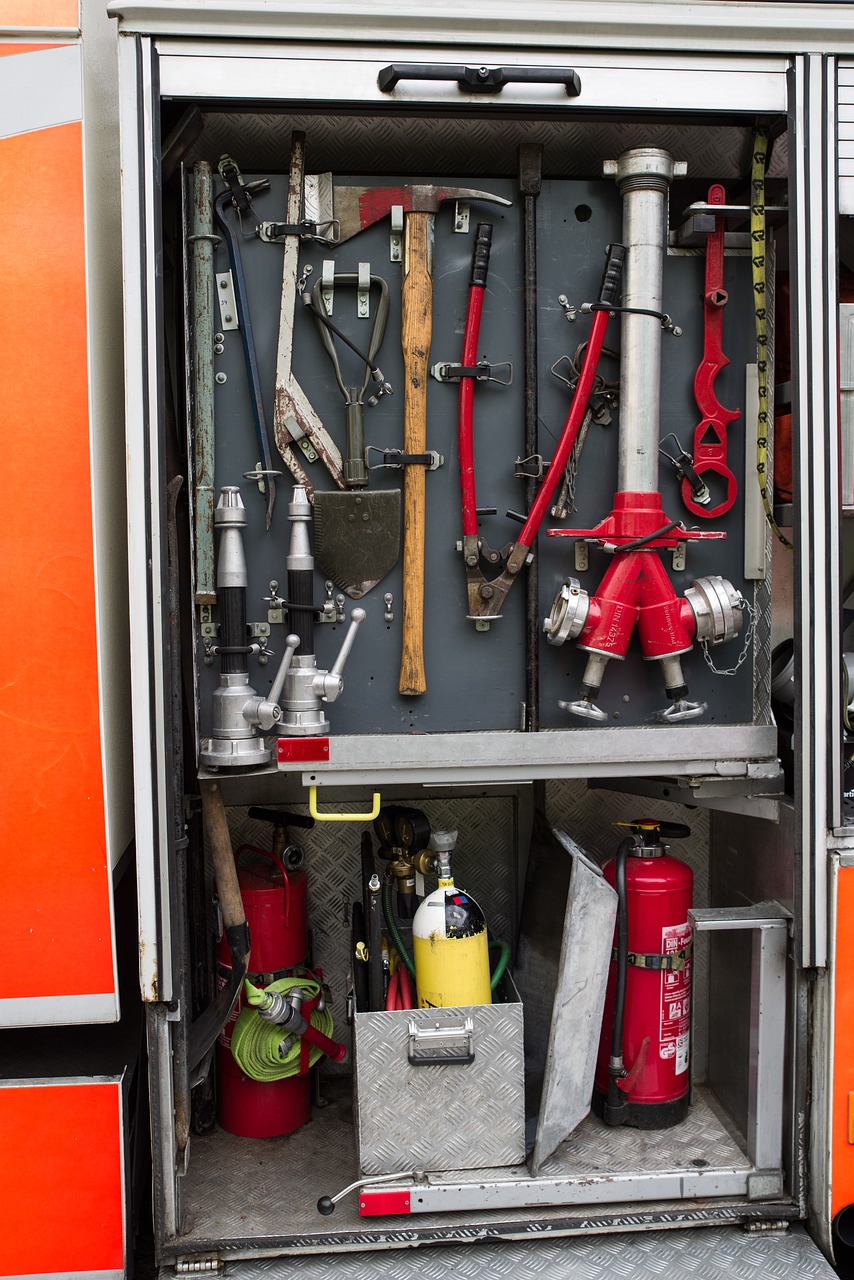
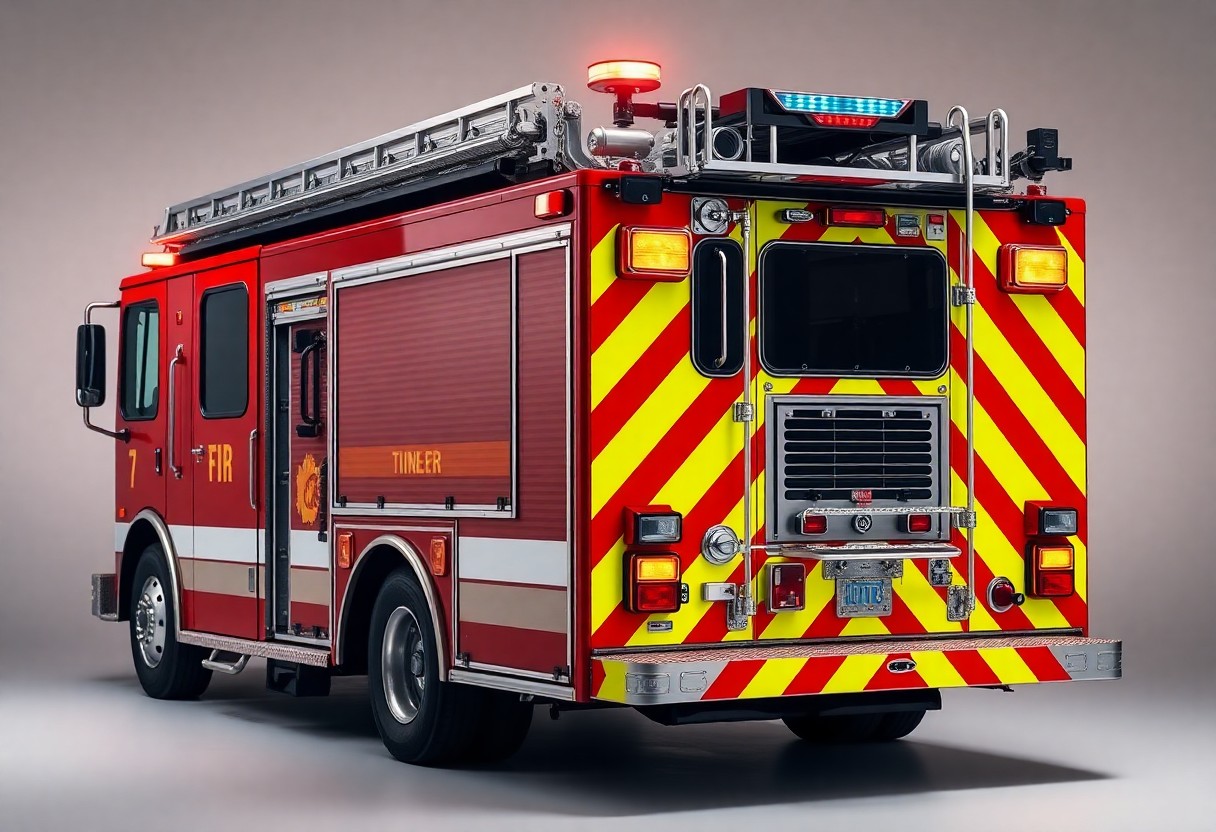

Most modern fire engines you rely on must carry high-capacity pumps, sufficient onboard water and foam, multiple hose lines and ladders, robust scene lighting, and reliable communications for command and dispatch. You should also have integrated driver-assistance and safety systems, thermal imaging cameras, secure SCBA and turnout storage, medical and extrication tools, portable lighting and power, and interoperability features that meet NFPA 1901 and local standards so your crew can operate safely and effectively.
Key Takeaways:
- Compliance and core systems: NFPA 1901‑compliant pump and plumbing with rated GPM/pressure, adequate onboard water tank, foam/CAFS capability, deck gun and monitored pump controls, plus hydrant/drafting fittings and hose preconnects for immediate attack.
- Firefighting and rescue equipment: properly configured hose loads (1.75″, 2.5″), nozzles, ground ladders, thermal imager, forcible‑entry and ventilation tools, hydraulic rescue tools, and integrated medical/ALS gear.
- Scene safety, support and communications: high‑output scene lighting and generator, PPE storage and SCBA cascade/refill, reflective conspicuity and crash protection, interoperable radios/GPS/AVl, and accessible electrical/maintenance systems.
Regulatory & Performance Standards
Applicable codes and standards (NFPA, ISO, regional)
You must align your engine with NFPA 1901 for pump, hose and electrical requirements, NFPA 1906 for wildland rigs, and ISO/IEC systems like ISO 9001 for manufacturer quality. Engines also need to meet emissions regimes – EPA Tier 4 Final in the U.S. or EU Stage V – and regional vehicle certifications. Typical pump capacities range 500-2,000 GPM; specifying standards upfront avoids rework and fleet nonconformance.
Certification, testing protocols and compliance documentation
Your engine must pass factory acceptance tests, hydraulic pump curves at rated net pump pressure (commonly 150 psi), hydrostatic pressure tests at typically 1.5× working pressure, and electrical EMC checks. Manufacturers provide FAT reports, calibration certificates, and declarations of conformity; departments often require a third‑party or lab-verified test report before placing apparatus in service.
Keep all compliance documents – pump test sheets, engine emissions certificates, component traceability, serial-numbered calibration records, commissioning reports and O&M manuals – organized for audits. You should retain test reports and maintenance logs for at least five years, and many insurers or grant programs demand third‑party validation (UL or accredited lab). Digital data logs and time-stamped photos speed acceptance and reduce disputes during handover.
Water Delivery & Pumping Systems
You depend on coordinated pumps, tanks and transfer hardware to sustain operations; municipal engines commonly carry pumps rated 1,000-1,500 gpm at 150 psi while smaller units run 500-1,000 gpm. Automatic priming, electronic pressure governors, redundant controls and compatible couplings (3″ hard suction, 6″ Storz) let you move water from hydrants, draft sites or tenders without interrupting an attack.
Pump capacity, priming, pressure control and redundancy
You should specify pump ratings that match your response area-1,000-1,500 gpm at 150 psi for urban engines and 500-1,000 gpm for light rescue units. Include vacuum or electric primers for rapid lift, an electronic pressure governor for steady nozzle pressure, and relief valves set to protect hose lines. Add redundancy with dual-stage pumps or an auxiliary transfer pump and a backup primer so a single failure won’t stop water delivery.
Tank capacity, drafting capability and transfer systems
You’ll commonly see 500-1,000 gallon engine tanks for quick interior attack and 1,500-3,000 gallon tenders for rural ops. Design drafting systems around a practical suction lift of about 20 feet using 3″ hard suction and Storz fittings. For shuttle operations, incorporate dedicated tank-to-tank transfer pumps or large-bore dump valves to sustain offload rates of several hundred to over 1,000 gpm.
You should also plan transfer plumbing and controls for real-world scenarios: use 6″ Storz for high-volume tanker shuttles, include check valves and flow meters to prevent backflow, and provide remote tank-to-pump switching so a single operator can manage offloads. Integrate low-water cutoffs and quick-connect foam transfer lines (e.g., 1.5″ eductors or proportional foam systems) to maintain foam accuracy during long-duration transfers and multi-tanker operations.
Firefighting Agents & Delivery Hardware
You need systems that carry and apply the right agents at required flow rates while meeting NFPA 1901 apparatus standards; that means onboard foam and proportioning capable of delivering Class A and B agents, hose and nozzles sized for both attack and supply, and quick-connect appliances to integrate with mutual aid. Engines should support multiple delivery modes-from 150 gpm handlines to deck/portable monitors exceeding 1,000 gpm-so your apparatus matches operational roles and incident demands.
Onboard foam systems, proportioners and Class-specific agents
You should specify foam tanks commonly sized 20-100 gallons and proportioners (venturi eductors, balanced-pressure, or bladder tanks) that accurately dose Class A at 0.1-1% and Class B at 3% (hydrocarbon) or 6% (polar solvent/AR agents). Compressed air foam systems (CAFS) improve coverage and knockdown on Class A fuels, while AR-AFFF or fluorine-free Class B agents are chosen based on hazard profile and environmental policy.
Hose, nozzles, monitors and quick-connect appliances
You want a package of 1.75″ attack lines (150-200 gpm), 2.5″ lines (250-325 gpm), and 4″-5″ LDH for supply; nozzle choices should include smoothbore tips, fog patterns, and automatic pressure-regulating models. Deck and portable monitors rated from ~500 to 2,000 gpm give you high-volume reach, and sexless Storz or NH/NST couplings plus gated wyes and adapters let you deploy and reconfigure lines rapidly with mutual-aid partners.
You must maintain hose and appliances to NFPA 1962 intervals: inspect, service-test, and replace damaged hose, verify nozzle flow and pressure settings, and keep spare fittings and hydrant adapters on-board. Portable monitor placement, remote-control options, and pre-connected LDH layouts cut setup time; training with the exact couplings and valve arrangements you carry reduces deployment errors during multi-agency incidents.
Crew Safety & Scene Protection
You need apparatus that protects crew inside the cab and around the scene: NFPA 1500 and NFPA 1901-driven features like certified seating and restraints, two-in/two-out operational support, collision-avoidance sensors, high-visibility striping, and integrated scene control (lights, cones, arrow boards) to secure work areas and reduce roadway incidents for your team.
Vehicle and occupant safety features (restraints, SCBA stowage)
Your engine should have approved seating for each rider with 3‑point lap/shoulder restraints, head restraints and harness-friendly seat geometry that accommodates SCBA. Stowage options include on-seat SCBA mounts or dedicated compartments with quick-release straps; size for your crew-typically 2-6 SCBAs-and provide clear access in under 10 seconds for rapid egress.
Scene lighting, thermal imaging, decontamination and PPE storage
You want powerful, shadow-minimizing LED scene lighting (telescoping masts and portable 20,000-40,000 lumen fixtures), helmet or handheld thermal imagers with spare batteries, onboard decontamination kits or fold-out showers, and segregated clean/contaminated PPE storage with ventilated, removable bins sized for an entire crew (4-8 sets).
Design lighting to be multi-angle: rooftop masts plus portable tripod units reduce shadows and glare, while vehicle-mounted inverters or 4-10 kW PTO-driven generators supply continuous power. Store TICs in quick-access compartments with spares and chargers; keep decon consumables, containment bags and an extractor or folding shower accessible within 60-90 seconds of entry to limit cross-contamination and speed post‑incident recovery.
Communications, Navigation & Incident Management Tech
Your rig needs integrated comms, navigation and incident management so crews act on the same information. Equipments that meet NFPA 1221 standards – P25 radios, redundant LTE/5G backhaul, in-cab MDTs and incident platforms like WebEOC or CommandCentral – keep voice, data and incident logs synchronized. This reduces dispatch-to-arrival variance, improves accountability during multi-agency events, and ensures encrypted dispatching, GPS tracking and post-incident audit trails are all available on-scene.
Radio interoperability, mobile data terminals and recording
You should fit multi-band P25-capable radios (Phase 1/2) and cross-band repeaters to talk across agencies; Phase 2 doubles voice channel efficiency in narrowband channels. Add in-cab MDTs with 4G/5G and offline mapping for CAD messages, plus integrated audio/video recording with searchable timestamps and 30-90 day retention policies tied to evidence needs. Examples include Motorola APX radios, Kenwood NX systems and MDTs running ESRI maps and CAD viewers.
GPS/CAD integration, telematics and remote diagnostics
Your engine must link CAD with GPS/AVL so routing and unit status are live on both ends; telematics should stream engine hours, pump hours and location to fleet systems. Integrations cut wasted driving and speed decision-making by showing nearest suitable apparatus, while remote diagnostics surface fault codes before failures. Use systems that export J1939/OBD-II data and fit into your CAD and maintenance platforms.
Drill down: telematics should capture J1939 CAN data (engine RPM, oil pressure, coolant temp, battery volts, DEF levels) and pump/ PTO engagement with timestamps tied to GPS. Configure alerts for fault codes (SPNs/FMI) and set thresholds for automatic work orders; vendors like Samsara, Zonar and Fleet Complete offer APIs to push telemetry into Asset Management and CAD. Doing so reduces unplanned downtime, shortens repair cycles and gives you historical performance for warranty claims and post-incident analysis.
Maintenance, Testing & Operational Readiness
You should treat maintenance and testing as continuous risk mitigation: daily operator checks, scheduled preventative service, and documented acceptance tests keep your engine available when calls come. Implement measurable readiness targets (for example, >95% fleet availability), tie repair turnarounds to service-level agreements, and align calendars with NFPA guidance so pump performance, brakes, lighting and SCBA charging systems are verified on predictable intervals.
Scheduled preventative maintenance and pump/flow testing
Run daily dash and pump-panel checks, perform monthly fluid, filter and belt service, and schedule annual pump acceptance and hose flow testing per NFPA guidance; for instance, verify a 1,500 gpm pump within ±10% of rated flow at rated RPM. You should also calibrate gauges yearly, exercise primers weekly, and document pressure relief valve and intake/discharge coupling inspections after any high-stress incident.
Recordkeeping, spare parts, training and lifecycle planning
You must maintain a searchable maintenance log (date, tech, mileage/pump hours, defects, corrective action) and a stocked spare-parts list with minimum quantities for critical items like pump packing and relief valves. Require 8-16 hours annual hands-on and classroom training per operator, schedule a mid-life refurbishment budget, and plan apparatus replacement on a 12-20 year lifecycle tied to condition-based metrics.
Dive deeper by specifying record fields (test results, torque values, serial numbers, vendor, warranty), using a CMMS with barcode-controlled inventory, and keeping 1-2 units of each critical spare (pump seals, primers, discharge adapters, electronic modules). Conduct quarterly inventory audits, run four hands-on pump drills per year, and schedule a pump overhaul around year ten or at a manufacturer-recommended hour interval to avoid unexpected failures.
Conclusion
With this in mind, your engine should combine a high-capacity, reliable pump and foam system, integrated SCBA and tool storage, modern radios and GPS, thermal imaging and scene lighting, safety features like ROPS and restraints, efficient hose layouts and quick-connects, and onboard power for electronics and medical gear; meeting standards means designing for rapid deployment, crew protection, interoperability, and adaptability to evolving tactics and hazards.