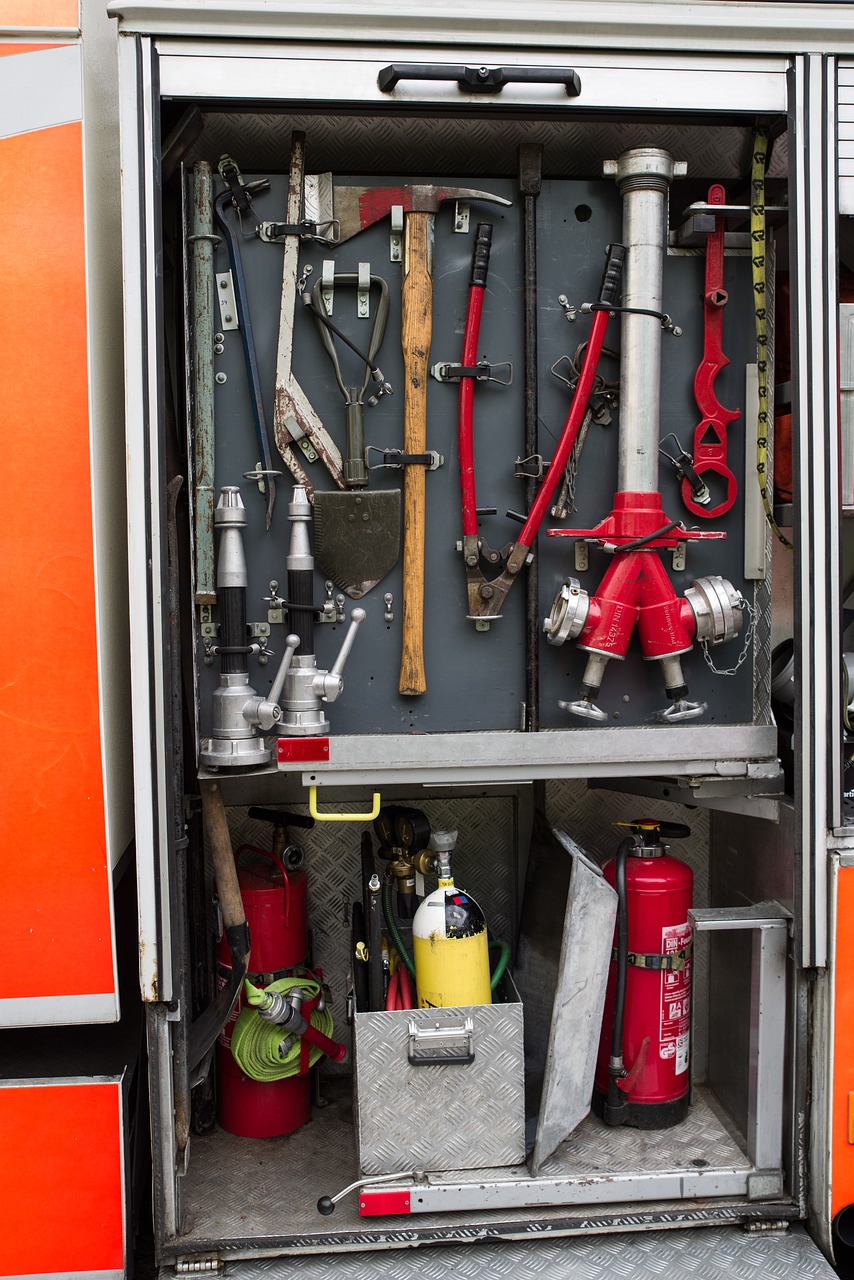
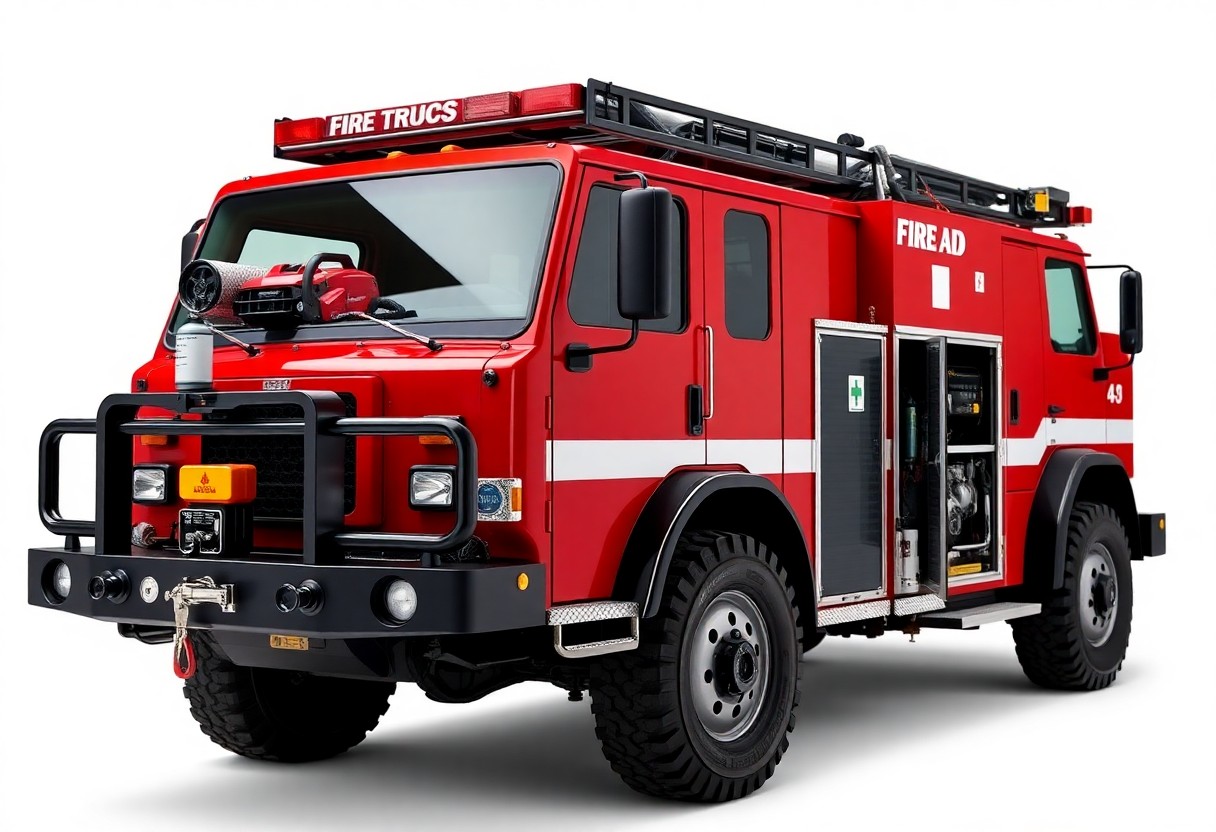
Many departments expect you to stock your brush truck with a balanced mix of wildland and rescue gear: water tank and pump or skid unit, attack hoses and nozzles, portable monitors, chainsaws and hand tools, PPE and shelter, basic and advanced medical supplies, stabilization and patient extrication tools (struts, spreaders, cutters), scene lighting, winch and towing equipment, radios and GPS, traffic control devices, and modular storage for rapid role changes.
Key Takeaways:
- Wildland firefighting package: skid or onboard water tank with pump and hose reels, foam system, portable tanks, hand tools (Pulaski, McLeod), chainsaw and fuel storage, and 4WD/off‑road chassis for access.
- Rescue and medical capability: ALS/BLS medical supplies, stabilization/cribbing, hydraulic/extraction tools or compact alternatives, rope/technical rescue kit, scene lighting, traffic control and a winch for vehicle recovery.
- Practical design and readiness: modular, quick‑access compartments, dedicated PPE and SCBA storage, onboard power/generator and compressed air, interoperable radios, clear labeling, and routine training/maintenance to ensure dual‑role effectiveness.
Vehicle platform & capability
Chassis, suspension, drivetrain and off‑road performance
Choose a heavy‑duty chassis like a Ford F‑550, RAM 5500 or Chevy/GM 5500 if you need GVWR up to 19,500 lb; for tighter trails many departments prefer F‑350/Silverado 3500 (GVWR ~13,000-14,000 lb). Diesel 6.7L Power Stroke, Cummins 6.7L or Duramax 6.6L give low‑end torque for pump and winch work. Fit 4×4 low‑range transfer case, locking diffs, 35″ all‑terrain tires, skid plates and upgraded shocks (Fox/Bilstein) for true off‑road capability.
Payload, weight distribution and towing considerations
Design the body so your water tank, pump and tools sit between axles to keep axle loads balanced; aim for usable payload of 3,000-7,000 lb depending on chassis. Confirm GVWR, GCWR and axle ratings before adding a 200-500 gal tank (water weighs 8.34 lb/gal). Account for 500-1,200 lb pump, hose reels and crew. Use weight distribution hitch and check tongue weight when towing trailers to avoid overloading rear axle.
Weigh each build on a certified scale after equipment installation and when loaded; a 300‑gal tank adds ~2,500 lb, so you must verify axle loads stay within rated 9,000-12,000 lb limits. Keep high items low to reduce rollover risk and use helper springs or air suspension to restore ride height. When towing, set tongue weight to roughly 10-15% of trailer mass and recheck GCWR to prevent transmission overheating or brake fade.
Fire suppression systems
Your brush truck needs suppression hardware that balances wildland reach with structural capability: reliable pumps, foam systems, CAFS options and enough plumbing to supply both attack lines and monitors. Choose components rated for continuous duty, easy maintenance and compatibility with your department’s foam concentrates. Expect pressure ranges and pump curves that allow both low-pressure CAFS at 70-100 psi and higher-pressure handline operations up to 150-200 psi so you can shift tactics between mop-up, exposure protection and confined-space rescue support.
Pump, tank size, hose, nozzles and foam delivery
Specify a pump in the 250-500 gpm range for true dual-role capability; smaller 150-200 gpm units limit monitor use. Tank volumes commonly sit between 200-500 gallons: 300 gal is a common compromise for extended wildland work and quick structure defense. Carry 1″ or 1¼” forestry hose reels (200-300 ft) plus one or two 1¾” attack lines and a 2½” supply. Fit smooth-bore and adjustable fog nozzles, and install a Class A low‑rate proportioner (0.1-1%) plus options for 3%/6% Class B when fuel hazards exist.
Portable monitors, skid units and rapid deployment appliances
Include slide-in skid units with integrated pumps and 100-500 gallon tanks for fast interchangeability, and portable monitors rated 250-1,000 gpm for exposure protection or structure defense. Rapid deployment appliances-reel-based quick-attack lines, collapsible drop tanks, and portable foam eductors-shave setup time to minutes. Mount skid tie-downs and quick-connect plumbing so you can swap units between rigs or launch a monitor while the main pump supports hand crews.
When you deploy a portable monitor, match its flow to your pump and supply hose: a 500 gpm monitor needs a pump that can sustain the flow and a 3″ or 2½” supply to minimize friction loss. Anchoring and elevation control matter-use base plates or earth anchors on uneven ground. For foam use, fit an in-line proportioner rated for the monitor’s maximum flow; in a typical structural-support scenario you might run a 300 gpm monitor with 0.5% Class A foam to protect exposures while crews conduct rescues.

Rescue and extrication equipment
You should outfit a brush truck so it can shift from fire attack to patient rescue in minutes: a compact hydraulic spreader/cutter set, battery-powered saws and pumps, cribbing and struts, basic rope kit and at least one Stokes basket or foldable litter, plus tarps and patient packaging gear. Prioritize gear that balances weight and capability so you can reach remote scenes without sacrificing a full extrication toolbox.
Hydraulic tools, battery tools and stabilization gear
Crew options include a lightweight hydraulic spreader/cutter/ram system (Holmatro or Hurst) with pumps or battery drives, plus cordless saws (Milwaukee M18/M12 or equivalent) for rapid access. Expect spreaders/cutters rated roughly 10,000-20,000 lbf and carry two battery packs per tool. Stabilization should include sets of cribbing (6-12 pieces), ratchet straps rated 5,000-10,000 lb, adjustable struts, airbags (2-20 ton range) and high-pressure hoses stored for quick hookup.
Patient care, tarps, stretchers and technical rescue basics
Keep a KED, three-size cervical collars, scoop stretcher, vacuum mattress and at least one Stokes or basket litter onboard, plus basic ALS/BLS kits (O2, BVM, O2 regulator, BP cuff, pulse ox). Tarps in 6×8 and 12×12/12×20 sizes protect patients and preserve scenes; folding gurneys save space when possible. For technical rescue bring 100-200 ft of 8-11mm rope, two locking carabiners, a belay device and webbing slings for anchors.
Operationally, you should stock redundancy: two tarps, a primary basket litter and a scoop or vacuum backboard for tight extrications, plus at least one portable oxygen cylinder and multi-parameter monitor. Train to deploy a KED and vacuum splint within 5-7 minutes for common MVA scenarios, and practice simple rope anchors and litter lowers so a two-person crew can stabilize, package and move a patient through rough terrain without waiting for additional units.
Wildland and brush‑specific tools
You outfit your brush truck with a balanced kit for wildland attack and rescue: Pulaskis, McLeods and rakes for line work; 16-24″ chainsaws with spare chains and fuel; portable pumps rated 20-100 GPM; and slip‑on tanks typically 150-500 gallons with foam capability, sized to match crew length and response distance based on local fuel models and terrain.
Hand tools, chainsaws, portable water pumps and slip‑on options
You carry 3-6 hand tools per crew-Pulaski, McLeod, shovel, rake-plus two chainsaws (one light duty, one 20-24″ for heavy timber) with spare bars and fuel containers. Portable pumps in the 20-100 GPM range and 1-2″ suction lines let you draft from ponds; slip‑on modules of 150-500 gallons with 10-25 GPM pumps and foam proportioners provide single‑unit autonomy on long access roads.
Brush guards, skid plates, skid sprayers and vehicle protection
You prioritize tubular or plate brush guards, full‑length skid plates and radiator screens to prevent disabling damage off‑road. Skid sprayers with 10-40 GPM pumps and 50-300 gallon tanks let you apply water while maneuvering. Add heat shields, reinforced bumpers and upgraded recovery points so your truck remains mobile after impacts or when traversing abrasive, rocky slopes.
You should specify 3/16″-1/4″ steel or reinforced 2″ tubular frames for front guards and bolt‑on AR‑grade skid plates under the transmission, transfer case and tank to resist punctures; mount skid sprayers centrally to lower the center of gravity, choose 12-25 GPM centrifugal pumps with stainless fittings, and fit remote nozzles plus foam injection-this combination lowers repair frequency and extends your operational endurance during multi‑hour wildland incidents.
Communications, lighting and electrical systems
You’ll want a tightly integrated setup: P25-capable radios with a vehicle repeater, GPS/AVL and an MDT/tablet for mapping, plus a 2-6 kW onboard generator, a 2,000-3,000 W pure-sine inverter and a 100-400 Ah battery bank with smart charging and BMS. Scene lighting should include a telescoping LED mast (20k-60k lumens) and several portable 10k-30k lumen lights. Design wiring, breakers and shore-power (30 A) so radios, lighting and rescue equipment can run simultaneously without brownouts.
Radios, GPS, incident command aids and interop equipment
You should outfit the truck with one mobile and at least two portables (P25 Phase 1/2, VHF/UHF/800 MHz or dual-band), plus a vehicle repeater to gain 3-10 dB effective range. Add AVL/GPS with 1-5 second position updates, an MDT or tablet with preloaded topo/street maps and ICS forms, and an interoperable gateway or crossband repeater for mutual-aid channels-many departments use Motorola APX or Harris radios with APX-style control heads and roof-mounted antenna diversity.
Scene lighting, onboard power, inverters and battery management
You’ll want a mast light (20k-60k lumens) for wide-area illumination, two to four portable LED floods (10k-30k lumens) and zoned perimeter lights; power them with a 2-6 kW PTO or portable generator, a 2,000-3,000 W pure-sine inverter, and a 100-400 Ah battery bank (LiFePO4 preferred for weight and cycle life). Include a 40-60 A shore/charger, DC-DC charger, automatic isolator and an LCD battery monitor so your comms and rescue tools stay powered.
Expect a 200 Ah 12 V battery (≈2.4 kWh usable) to run a 1,200 W light mast roughly two hours; switching to LiFePO4 can double usable capacity and allow 80-90% discharge without damage. Mount inverters and chargers on vibration-isolated brackets, fuse each circuit near the battery, route shore power through a GFCI inlet (30 A) and fit automatic load-shedding to prioritize radios and hydraulic tool power during extended incidents.
Operational policy, training and maintenance
Embed policies that tie dual-role expectations to measurable actions: set turnout targets (for example, 5-7 minutes), require incident reports within 24 hours, and mandate post-incident after-action reviews after any multi-unit response. You should align these with NFPA 1500 safety guidelines and local mutual-aid agreements, and schedule quarterly policy reviews to incorporate lessons learned and update equipment manifests.
Standard operating procedures, role definitions and crew training
Define clear roles on the brush truck-driver/operator, wildland team lead, and rescue/medical technician-with required cross-certifications. You should require NFPA 1001 baseline skills, aim for 24 hours of annual cross-training plus monthly 2-hour scenario drills, and measure performance with task times (e.g., hose deployment under 3 minutes, pump hookup under 5 minutes) to validate SOPs under stress.
Inspection schedules, inventory control and serviceability
Adopt a tiered inspection regime: pre-shift 5-10 minute checks, weekly functional runs, 30‑day inventory audits, and annual NFPA 1911 apparatus service. You should track consumables via barcodes or a CMMS, set minimum stocking levels (for example, two spare hose lengths and two portable pump spares), and remove or tag unserviceable items within 24 hours to preserve readiness.
Sample schedule you can adopt: pre-shift checklist (fuel, lights, oil, tire pressure – 5-10 minutes), weekly (run pump 10-15 minutes, start saws, test radios), monthly (complete inventory count against the manifest, replace expired PPE, battery load test), quarterly (hose-pressure test, engine service per mileage), and annual NFPA 1911 certification. Implement CMMS entries within 24 hours, use color-coded service tags, and keep a two-week forecast of replacement parts to avoid mission gaps.
To wrap up
Presently you should equip your brush truck for dual-role fire and rescue with a water tank and pump, interchangeable hoses and nozzles, foam and portable pumps; wildland hand tools (Pulaski, rakes, shovels) and chainsaw; basic extrication kit (battery cutters/spreaders), medical trauma pack, stabilization and cribbing, powerful scene lighting and generator, reliable radios, PPE for both wildland and technical rescue, traffic/scene control gear, and a thermal imager.