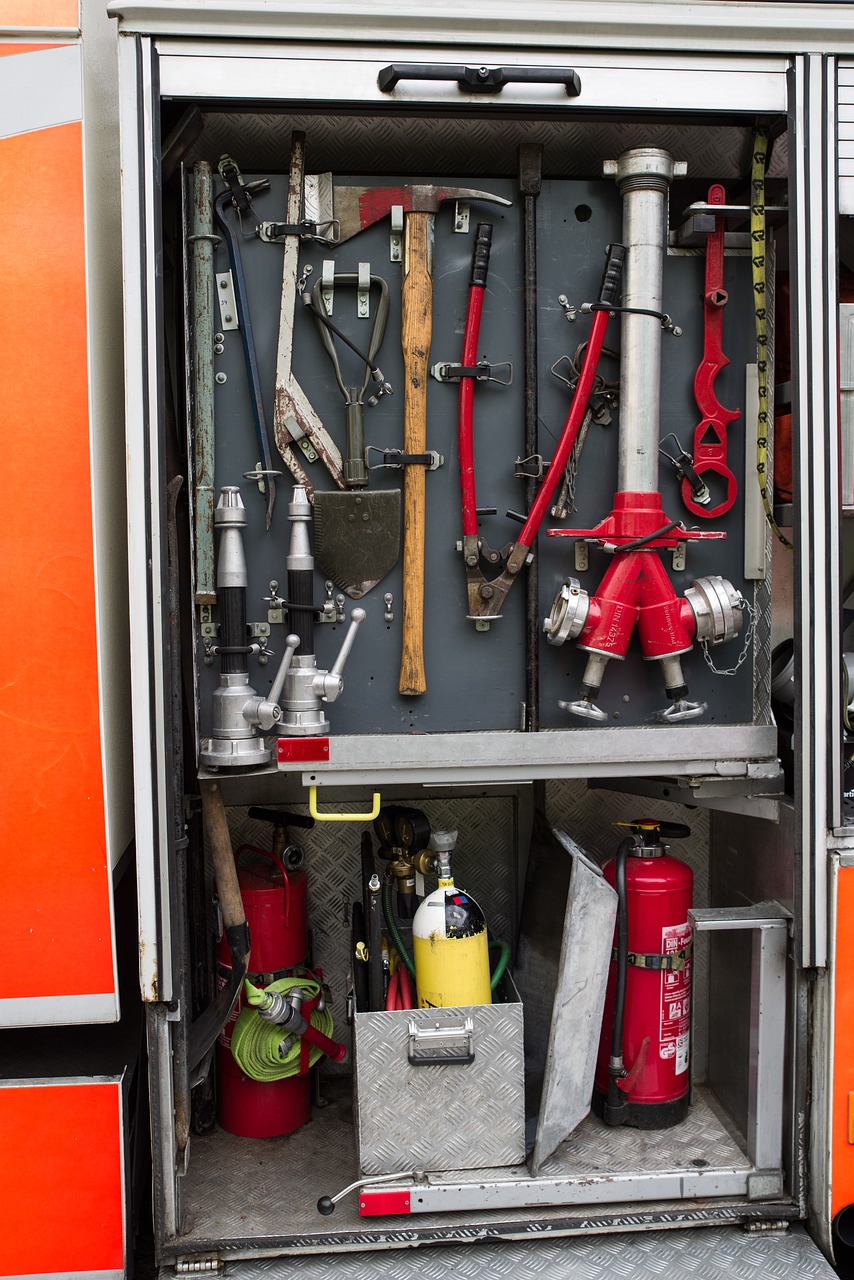
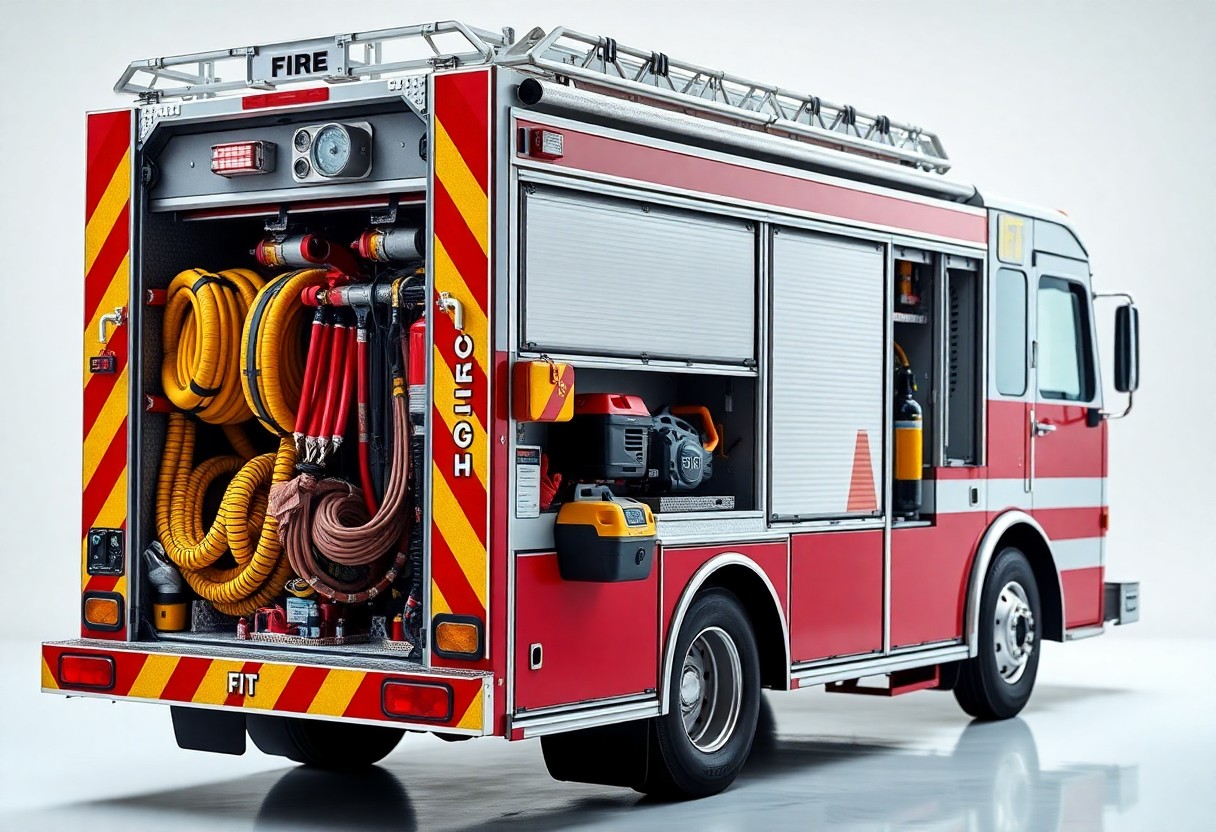
With a properly outfitted engine, you give your crew the tools to handle fires, medical emergencies, and technical rescues – reliable pumps and hoses, varied nozzles, SCBA with spare cylinders, advanced airway and trauma supplies, extrication gear, thermal imaging cameras, portable lighting and power, robust radios, and full PPE inventories. You also need organized storage, preventive maintenance, and standardized checklists so your unit stays inspected, crew-trained, and always ready to deploy.
Key Takeaways:
- Standardized, mission-specific equipment inventory on every engine: SCBA and spare cylinders, charged hose and nozzles, portable pump and fittings, ladders, forcible-entry and ventilation tools, thermal imaging, and full PPE for all crew.
- Consistent preventive maintenance and readiness checks: daily/weekly apparatus inspections, pump and hose testing, battery and electrical system verification, inventory audits, and up-to-date service records to prevent equipment failure on scene.
- Operational systems and crew proficiency: reliable communications and scene lighting, interoperable fittings and medical gear, clear labeling and SOGs, and regular hands-on training to ensure crews can deploy equipment safely and efficiently.
Life‑Safety and Medical Equipment
You outfit your engine with ALS-grade monitors, airway tools, oxygen systems, and a full trauma cache to support extended on-scene care and transport. Include at minimum one 12-lead-capable monitor/defibrillator with pediatric pads, manual energy up to 360 J, suction ≥30 L/min with 6-14 Fr catheters, adult and pediatric BVMs, and calibrated oxygen regulators with spare portable cylinders and a bulk supply connection.
Cardiac monitor/defibrillator, airway management, and oxygen systems
You should carry a 12-lead monitor/defibrillator (biphasic up to 360 J) with CPR feedback and pediatric pad sets, plus spare batteries and mounting. For airway, stock video and direct laryngoscopes, ET tubes sizes 6.0-8.0 adult and 3.0-5.5 pediatric, supraglottic devices, bougie, and oral/nasal airways. Oxygen setup must include regulator, non-rebreather, nasal cannula, two BVM sizes, and a suction unit meeting scene demands.
Trauma supplies: hemorrhage control, splints, and burn care
Your trauma cache should include at least two commercial tourniquets (CAT or SOFTT), multiple hemostatic dressings, chest seals, and junctional control devices. Add pelvic binders (SAM), a range of rigid and vacuum splints, traction for femur injuries, sterile burn sheets, hydrogel dressings, and a stock of 4×4 and 8×10 sterile gauze. Keep pediatric-sized items accessible and replenishment protocols in place.
Place tourniquets and hemostatic dressings in external, easily accessible compartments-two tourniquets per responder and four hemostatic packs per apparatus is a practical standard. Color-code pediatric versus adult packs, carry two pelvic binders and one vacuum splint per patient, and include at least two 0.5-1 m² sterile burn sheets plus hydrogel packets for partial-thickness burns. Perform monthly inventories and swap expired hemostatic agents and sterile supplies immediately.
Self‑Contained Breathing and Personal Protection
SCBA, spare cylinders, and rapid‑air replacement systems
NFPA 1981-compliant SCBA with 30-, 45- or 60‑minute cylinders (commonly 4,500 psi) should be on your engine; many departments stock at least two spare 45‑minute bottles per apparatus. Rapid‑air replacement setups-cascade carts, on‑board refill modules, or quick‑swap harnesses-let you top off or exchange bottles on scene, often reducing cylinder changeover to under 30 seconds per firefighter while maintaining integrated PASS and facepiece integrity.
Turnout gear, helmets, gloves, and decontamination supplies
You should carry full NFPA 1971 turnout ensembles, NFPA 1972/1851 inspection and care protocols, multiple helmets, structural gloves, hoods and boots, plus decon supplies such as gross‑decon bags, soap/neutralizer wipes and an extractor‑friendly gear bag. Inspect gear after every use and perform advanced inspections and cleaning per NFPA 1851 intervals; keep spare gloves and hoods accessible for rapid replacement during rehab or contamination events.
Store spare turnout sets and helmets in dedicated, labeled compartments or sealed gear bags to prevent cross‑contamination; carry at least one extra hood and two pairs of structural gloves per crew position when possible. Implement a log for inspections, note service life issues (rips, seam failures, damaged thermal liners) and retire or send for repair immediately when integrity is compromised. Use manufacturer‑approved extractor cycles and avoid bleach-based cleaners to preserve thermal barriers and reduce long‑term degradation.
Fire Suppression and Appliance Readiness
Keep pumps, lines, and appliances inspected to the same operational standard you expect from your crew: perform the annual pump performance test at the pump’s rated capacity (commonly 1,250-1,500 GPM on municipal engines), log lubrication and valve operation, and run hose and nozzle checks weekly. You should tag and remove failed hose, verify intake and discharge gauges, and cycle foam proportioning systems monthly so your apparatus delivers expected flow and pressure when seconds matter.
Pumps, hose, nozzles, foam systems, and hydrant/relay tools
Carry a mix of attack and supply options: 1.75″ attack lines and 2.5″ supply lines, nozzles rated 95-200 GPM, smoothbore options for high-flow needs, and portable foam eductors or onboard proportioners. You should stock Storz adapters, gated wyes, hydrant spanners, and LDH relay fittings, practice setting up pumper-to-pumper relays, and maintain spare hose clamps and adapters so you can establish and sustain flows in urban and rural water-shy environments.
Thermal imaging, portable lighting, and forcible entry equipment
Equip engines with at least one TIC (320×240 sensor class, 2-4 hour battery life), handheld LED lights (500-2,000 lumens) and a collapsible scene light (10,000-30,000 lumens), plus forcible tools: Halligan, flathead axe, K-tool, hydraulic spreader/cutter or battery-powered alternatives, and a rotary saw with spare blades and fuel. You must keep batteries charged, blades sharp, and TIC lenses clean so detection, access, and scene illumination are reliable on every call.
During interior searches and overhaul you’ll rely on the TIC to locate hot spots and victims behind walls or heavy smoke, while portable LEDs eliminate shadowed zones and glare. Practical maintenance matters: rotate your TIC batteries weekly, bench-test hydraulic tools monthly under load, and inspect forcible entry sets for bent shafts or dulled edges after every use. In training, run timed forcible-entry drills and dark-house TIC/lighting scenarios so your team hits target benchmarks under pressure.
Rescue and Extrication Capabilities
Your engine should carry a balanced mix of heavy and light rescue tools, scene lighting, and rapid-access storage so your crew can handle vehicle extrication, structural collapse, and technical rescues. Include at least one battery/hydraulic combo unit, a set of stabilization struts, airbags rated 10-50 tons, and modular lighting (10,000 lumens) to operate through the night; organized inventory and quick-deploy racks cut scene time by minutes when every second matters.
Hydraulic rescue tools, stabilization struts, and cribbing
Keep a hydraulic toolset (spreader, cutter, ram) capable of ~10,000 psi performance plus a battery backup for remote scenes, paired with stabilization struts rated up to 20,000 lb and hardwood cribbing in 4×4 and 6×6 blocks. You should also stock pneumatic lifting bags (10-50 ton capacity), interchangeable hose reels, and a compact ram adapter kit so your team can adapt to passenger vehicles, heavy trucks, and overturned equipment without calling for additional resources.
Rope/technical rescue gear and patient packaging equipment
Store 10.5-11 mm static kernmantle ropes in lengths 50-200 m, rescue-rated carabiners (25-32 kN), directional pulleys, friction devices, and pre-rigged anchor straps so your team can build mechanical-advantage systems quickly. Include patient packaging like vacuum mattresses, SKED stretchers, rigid spine boards, and cervical immobilizers; having one confined-space kit and one high-angle kit on the engine shortens response times on multi-discipline incidents.
Inspect and log all rope and hardware per NFPA 1983 standards, retire ropes after a major fall or visible damage, and consider a 5-10 year maximum service life depending on use; replace webbing or slings showing abrasion or UV degradation immediately. Train monthly to rehearse packaging options-vacuum mattresses for torso-contoured support, SKEDs for confined-space extraction, and scoop boards for hip/pelvic stability-so your crew knows which device to use and how to transition patients safely under load.
Communications, Navigation, and Incident Support
Portable radios, MDTs, GPS, and interoperable systems
Equip your crew with P25-capable portable radios (VHF/UHF) supporting AES encryption and at least 128 channels, plus spare batteries and rapid chargers. Integrate MDTs with CAD and GIS mapping so you can pull hydrant locations, preplans, and HazMat data en route; GPS accuracy of 3-5 meters keeps unit positions reliable for accountability. Plan mutual-aid talkgroups and gateway interfaces to ensure you can talk across agencies during multi-jurisdiction incidents.
Scene lighting, traffic control devices, and incident command aids
Telescoping LED floodlights and portable light towers (20,000-40,000 lumens typical) give you usable scene illumination for 8-12 hours on battery or generator power. Stock 18-36 inch cones, Type II/III barricades, LED road flares, and portable arrow/message boards so you can establish secure perimeters and safe lane closures. Add magnetic ICS boards, placard systems, and accountability tagboards so your command post stays organized under pressure.
Position lighting to avoid glare into apparatus and crews-raise towers 20-30 feet and sit them 50-75 feet from the work area to reduce shadows; angle extra handlights for patient care zones. Use message boards 300-800 feet upstream depending on roadway speed and stagger cone spacing for clear tapers. Keep cable ramps, high-visibility signage, and at least one portable generator or battery bank on every engine to maintain lighting and message boards throughout prolonged incidents.
Logistics, Maintenance, and Readiness Processes
Standardize schedules, SOPs, and documentation around NFPA 1911 to keep apparatus available; you should track uptime, mean time to repair (MTTR), and days out of service. Use digitized work orders and dashboards to prioritize items that drop below set availability thresholds, and assign responsibility for corrective actions so downtime under 5% becomes an operational goal rather than an aspiration.
Daily/weekly checks, preventive maintenance, and charging stations
Perform daily walkarounds (15-20 minutes) checking fluids, belts, lights, tire pressure, pump oil, hose condition, and radio/lighting operation; run the pump briefly under load weekly and exercise the generator for 20-30 minutes. Set charger bays with labeled slots, voltage meters, and a battery-management log so you charge lithium tool packs after every shift and rotate batteries to avoid deep-discharge damage.
Inventory control, restocking protocols, and spare parts management
Establish par levels using average monthly usage and supplier lead times (typically 7-21 days), categorize spares (A: mission-critical, B: routine, C: long-lead), and implement FIFO plus barcodes or RFID for traceability. You should keep critical items-pump seals, belts, couplings, starter motors, battery packs-on-site, configure automated reorder points, and document vendor SLAs to avoid emergency procurement.
Implement monthly cycle counts for high-turn items and a full annual audit; use inventory software that generates reorder alerts and records lot numbers and service dates. For consumables with test intervals-hoses and pumps (annual), cylinders (hydrostatic every 5 years)-tag items with expiration or test dates and use vendor-managed inventory or consignment for bulky, low-turn spares to lower capital tied up in stock while ensuring rapid access when you need parts immediately.
Conclusion
To wrap up, you should outfit your engine with reliable PPE and SCBA, well-maintained pumps and hose, redundant communications, forcible-entry and mechanical tools, medical and rescue equipment, spare parts and fuel, and clear checklists for daily inspections and maintenance, so your crew can deploy safely and your apparatus stays mission-ready.