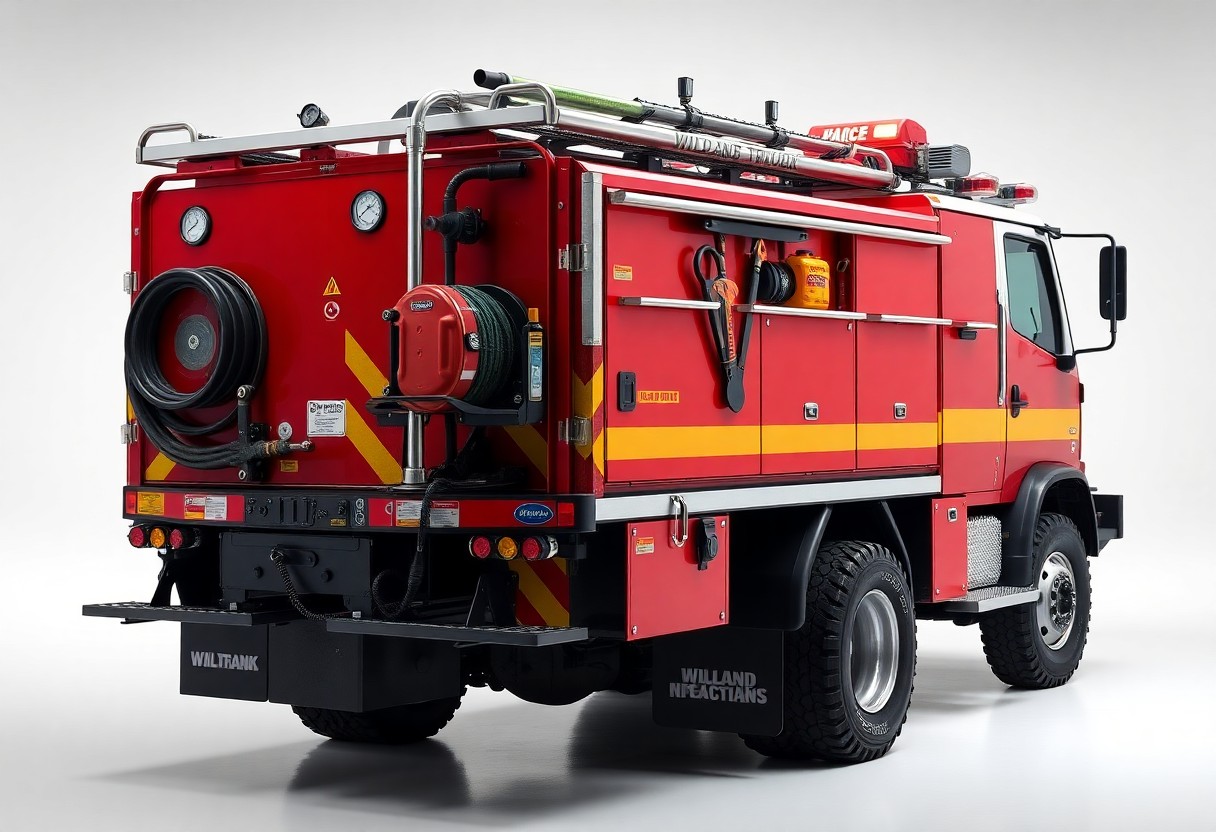
Brush trucks should carry a compact, prioritized kit for effective wildland response: a reliable pump and adequate water tank with hose lines, fittings and foam, hand tools (Pulaski, shovels, rakes), chainsaw and spare fuel, full PPE and fire shelters, portable radios, lighting and GPS/maps, first-aid and burn care supplies, spare parts, traffic control gear, and recovery equipment for off-road mobility so you can operate safely and sustain operations in remote terrain.
Key Takeaways:
- Water delivery and suppression gear – reliable pump sized for wildland use, adequate onboard tank capacity (commonly 200-500+ gallons), hose reels and attack lines with adjustable nozzles, quick-connect fittings, foam proportioner and portable/fold‑a‑tank for water transfer.
- Hand and power tools plus PPE – Pulaski, McLeod, shovels, rakes, chainsaw with spare bar/chain and fueling kit, and wildland-rated personal protective equipment (helmets, gloves, fire‑resistant clothing, eye/face protection) plus a comprehensive first‑aid/trauma kit.
- Communications, navigation and support systems – VHF/portable radios with spare batteries, GPS/mapping tools, scene lighting and traffic control gear, pump‑to‑pump fittings, spare hose and adapters, and basic maintenance/repair tools.
Vehicle Platform & Mobility
Your brush truck should balance maneuverability and payload: a 1-ton chassis (F‑350/F‑450, RAM 3500, Silverado 3500) with GVWR in the 10,000-14,000 lb range gives common commercial parts and 2,000-6,000 lb payload for water, pump, and tools. Choose a short to mid wheelbase for tight forest roads, at least 9-12 inches of ground clearance, 4×4 low‑range capability, and approach/departure angles that let you negotiate ridgelines and steep firelines without grounding the body or tank.
Chassis, drivetrain and off-road capability
Fit a reinforced ladder frame or aftermarket subframe and spec a high‑torque diesel (for example 6.7L Power Stroke or 6.6L Duramax) with tow/haul transmission programming; you want low‑range transfer case, locking differentials, and axle ratios that sustain low‑speed pulling under load. Upgrade suspension with heavy‑duty springs, helper airbags or progressive coils and monotube shocks (Fox/Bilstein), which improve wheel travel and reduce bottoming on rocky fire trails.
Tires, recovery points and underbody protection
Select LT tires sized 33-37″ with load range E or higher and reinforced sidewalls to resist punctures; carry a full‑size matching spare and a portable air compressor for on-scene pressure adjustment. Install frame‑mounted recovery points/D‑rings rated 10,000-30,000 lb and a front winch in the 9,000-16,000 lb class. Protect the drivetrain with welded skid plates (3/16″-1/4″ AR or equivalent) under the transfer case, oil pan, and fuel tank, plus rock sliders at the rocker panels.
Further detail: your tire strategy should include a monitored TPMS and a repair kit with a sleeve patch and CO2 inflator; for recoveries bring kinetic rope (8-11 m), rated bow shackles, a snatch block to double winch line capacity, and tree savers. Underbody armor benefits from full‑length belly pan mounting to the frame with grade‑8 fasteners, and consider replaceable wear plates at high‑impact zones to simplify field repairs after abrasion from branches and rocks.
Water, Pumps & Tank Systems
Your brush truck’s water, pump and tank choices determine how long you can sustain an attack, support relay operations, and protect exposures; match tank size, pump capacity and foam capability to the terrain and incident type so your unit isn’t the limiting link during a prolonged shuttle or long-hose lay.
Tank capacity, baffling and foam injection
Choose tank sizes commonly between 200-500 gallons for brush trucks; 300-400 gal balances weight and endurance for most wildland runs. Proper baffling minimizes slosh on steep grades and improves vehicle control. Fit a Class A foam system with eductor or direct injection capable of 0.1-0.5% mixes so you can extend knockdown effectiveness on spot fires and structure protection without overloading the pump.
Pump type, flow/rated pressure and relay capability
Equip your unit with a centrifugal or midship pump in the 150-500 GPM range rated to 150-250 PSI to handle handlines and relay duties; PTO-driven or engine-driven options give sustained output, while a reliable priming system (vacuum or positive displacement primer) ensures rapid drafting from portable ponds or tanks during shuttles.
When choosing pump capacity, consider call volume: a 250 GPM pump at 150 PSI suits most initial attack and quick structure protection, while a 500 GPM pump supports long relay stretches and faster refill cycles. Study pump curves to match expected duty points, install pressure governors or electronic throttle control for stable nozzle pressures, and verify relay performance over typical hose lengths in your response area during acceptance testing.
Fire Suppression Delivery & Tools
Most brush trucks pair a 250-500 GPM pump with a 200-750 gallon tank so you can sustain direct attack without immediate water resupply. You should outfit reels and hose for rapid deployment-1″ to 1.5″ forestry hose for handlines and larger 1.5″-2.5″ lines for structure defense. Include CAFS capability to extend water reach and improve extinguishment, and store spare nozzles, adapters and fittings for common hydrant and hard suction connections.
Nozzles, hose reels, CAFS and handlines
Select nozzles that deliver 10-30 GPM for mop-up and direct flame contact, with a 95 GPM option for structure standby. You’ll want at least one pistol-grip adjustable nozzle and one fog/straight bore for different attack modes. Hose reels should carry 200-300 ft of 1″ forestry hose for quick initial attack. When using CAFS, set Class A foam at 0.1-0.5% to improve wetting and burn-back resistance.
Ground tools: brushes, rakes, chainsaws and portable pumps
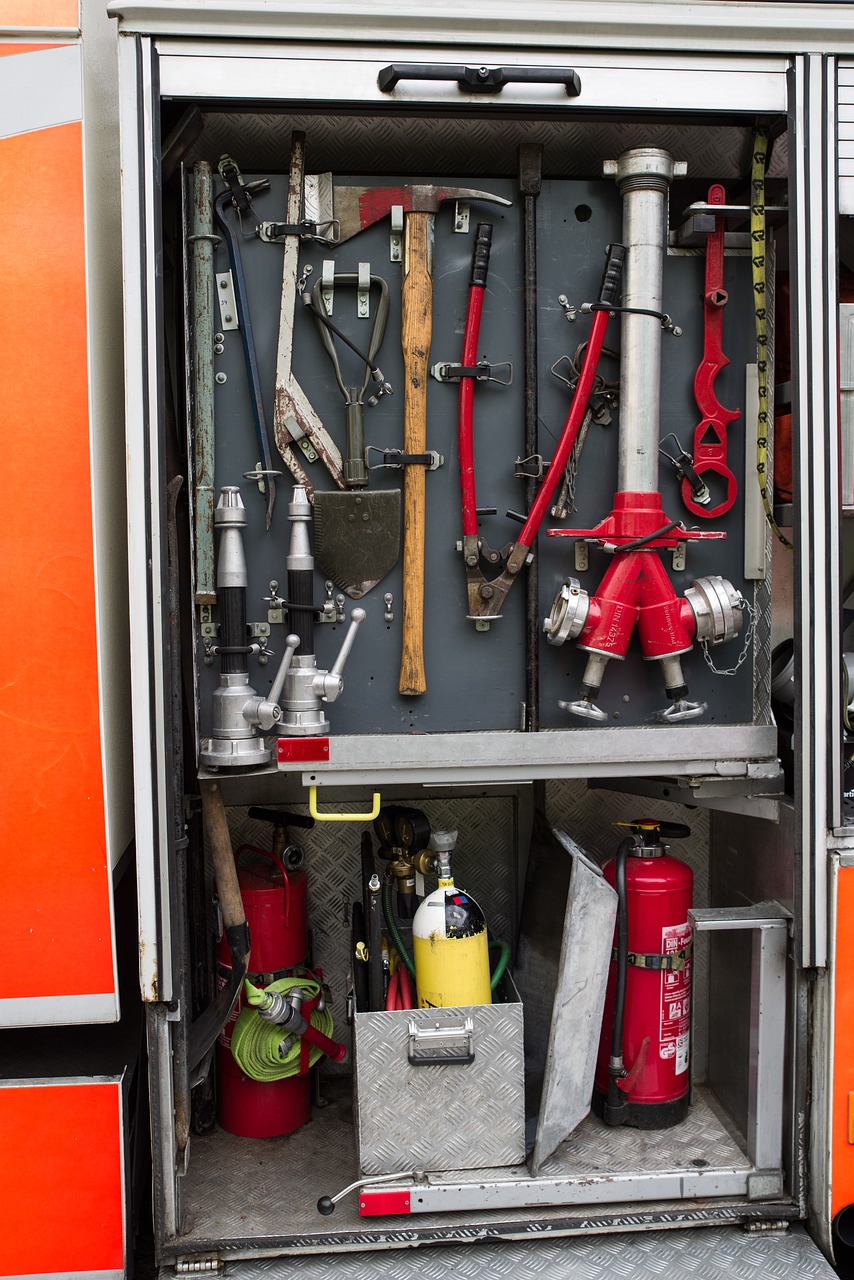
Stock McLeods, Pulaskis, shovel variants, flappers and rake hoes so your crew can build and hold handlines; a typical cache includes 3-6 of each tool per apparatus. Carry chainsaws with 16″-20″ bars and spare chains, together with approved fuel and PPE. For water delivery away from the truck, include at least one portable pump-2″ trash pumps or lightweight petrol pumps rated 50-200 GPM work well.
Organize ground tools for rapid tasking: place saws and fuel in a separate locker, tools grouped by type, and pumps with suction hose and foot valves ready to deploy. You should rotate chains and sharpen bars after every shift; keep spare impellers, spark plugs and a basic pump toolkit on board. In practice, staging two saw teams and a pump operator lets you construct handlines and draft from a nearby source while the engine crew holds the attack line.
Storage, Organization & Quick Access
You optimize response by designing storage for speed: assign fixed locations for PPE, hand tools, and lines so you grab gear in under 10 seconds, and use color-coded straps, inventory tags, and a visible parts list. Many departments stash 150-300 ft of handline, two chainsaws, and a spare blower in dedicated racks, while modular trays and QR-coded inventory sheets cut search time and simplify post-incident restocking.
Compartment layout, racks and secure mounts
You arrange compartments by function-hose and pump gear at the rear, PPE and medical at waist height, heavy tools low and secured-and install quick-release mounts so a two-person crew can access main tools simultaneously. Use vestibule clearance of at least 18″ for tool deployment and mount chainsaws in vented, lockable saddles to prevent shifting and heat buildup.
Compartment examples
| Rear hose bay | 300 ft 1″ single-jacket hose on roller, 1.5″ adapter, quick-deploy strap |
| Driver-side mid | PPE lockers, two wildland packs, SCBA stow with pull tabs |
| Passenger-side lower | Chainsaw rack (vented), fuel box, tool mounts for Pulaski and rakehoe |
| Roof/top rack | Foldable ladder, portable pump, secured water canisters with tie-downs |
Hose beds, fittings, adapters and rapid-deploy systems
You outfit hose beds with both pre-connected speedlays and bulk storage: typical setups carry 200-400 ft of 1″ wildland hose plus 200 ft of 1.5″ or 2″ supply lines. Include a minimum of two 1.5″ to 1″ reducers, one gated wye, and sets of NST, GHT and Storz adapters for mutual-aid compatibility, mounted in labeled trays for instant use.
You prioritize deployment speed by using spring-assisted rollers, 12″ diameter hose trays, or reel systems that let you pull 200 ft in 20-30 seconds. For fittings, carry at least three adapter types (NST, Storz, GHT) plus spare swivel couplings and pipe thread tape; crews that pre-stage gated wyes and ball valves on pre-connects cut hookup time by half during initial attack.
Crew Safety & Ergonomics
Position seating for 3-6 crew members forward-facing with shock-mounted, energy-absorbing seats and integrated lumbar support to reduce jolt and fatigue on rough lines. Use 3- or 4-point restraints per NFPA 1906 and place PPE storage within arm’s reach of doors so you can don gear in 45-60 seconds. Keep clear egress paths, illuminated grab handles, and anti-slip surfaces to speed exit while wearing gloves and packs.
Seating, restraints, PPE storage and egress
Fit seats rated for off-road use with quick-adjust mechanisms and harness attachments that accept SCBA loads; aim for seating for 4-6 with removable jump seats for versatility. Install ventilated, labeled PPE lockers and quick-release SCBA racks so you can grab helmets and gloves without stepping out. Provide at least two unobstructed exits, high-visibility step edges, and 12-14″ step heights to help you get out quickly while encumbered.
Thermal protection, lighting and scene safety equipment
Carry NFPA 1977-compliant wildland PPE (Nomex layers), one fire shelter per crewmember, and aluminized shielding for vehicle protection. Equip the truck with 10,000-20,000-lumen roof scene lights plus two portable 5,000-lumen floods and headlamps so you can achieve full 360° illumination. Store reflective vests, four traffic cones, battery strobes, and a compact thermal imager to find hotspots and mark safe zones.
You should specify articulating LED scene lights with 5,000-6,500K color temp and CRI >70 for true color rendering, and require portable floods with 4-8 hour run-times and spare battery packs. Use a thermal imager with 320×240 resolution or better to spot deep-seated heat along containment lines and in mop-up; agencies report faster hotspot detection and fewer rekindles when TI-equipped. Keep PPE lockers ventilated and drainable, inspect fire shelters after each use, and test lighting batteries daily so your crew can operate safely at night or in heavy smoke.
Communications, Navigation & Incident Technology
You need resilient, redundant comms and situational tech that perform off-grid and on-scene; mix FirstNet/LTE for data with VHF/UHF and 800 MHz P25-capable radios for voice interoperability, plus portable repeaters and mesh options for blackouts. Equip tablets with offline GIS layers and preloaded ingress/egress routes, keep spare batteries and hardened chargers, and carry a small satcom terminal or satellite messenger for areas without cellular coverage.
Radios, interoperability and GPS/mapping
Pack P25-capable portables that can fall back to analog, program 20-40 mission channels (tactical, strike team, mutual aid), and include an 800 MHz mobile and a VHF/UHF portable. Add a vehicle-mounted repeater or crossband gateway for range. For navigation, carry a dedicated GPS (Garmin GPSMAP or inReach) plus two tablets with ArcGIS Collector or Avenza Maps and preloaded offline shapefiles, waypoints, and evacuation routes.
Incident command aids, sensors and lighting systems
Bring rugged tablets with ICS forms and a digital whiteboard app, a portable ADC or ICS-209 export capability, and printed IAP templates as backup. For sensing, include a thermal camera (FLIR or equivalent), a small mapping UAS (DJI Mavic 2 Enterprise or Matrice series), and a particulate/air-quality monitor. Lighting should be LED scene lights or a 2-5 kW generator with 10,000-30,000 lumen towers and rechargeable handlights for structure and night operations.
Integrate sensors into your command flow by streaming drone ortho imagery and thermal overlays to tablets via LTE/FirstNet or a local Wi‑Fi bridge; use thermal for hotspot verification and UAS for rapid 1-2 km perimeter mapping. Manage power with a 1,000-3,000 Wh battery bank for lights and electronics, stash spare drone batteries (2-4 per aircraft), and assign one tech to handle data feeds so your IAP updates remain current and actionable.
To wrap up
With these considerations, your brush truck should carry a dependable pump and tank, foam/retardant capability, varied hoses and nozzles, portable pumps or skid units, hand tools (Pulaski, McLeod, rakes), chainsaws and spare fuel, comprehensive PPE and escape gear, reliable radios/GPS and lighting, medical and traffic-control equipment, and basic maintenance/repair supplies; you must also ensure fittings, pressure ratings, and crew training match expected wildland conditions.