Most brush trucks assigned to large rural areas must carry a balanced mix of water, pumps, portable tanks, hose reels, and line personnel safety gear so you can establish rapid attack and sustained supply; include a reliable 4×4 chassis, a skid unit with at least 200-500 gallons or a water tandem depending on terrain, portable pumps, 1 1/2-2 1/2 inch hoses, hand tools, chainsaws, lighting, navigation/GPS equipment, medical kit, and communications to keep your crew safe and effective.

Key Takeaways:
- Mobility & recovery: 4×4 chassis with high clearance, off-road tires, winch, recovery straps, extra fuel and a spare tire to reach and exit remote, rough terrain.
- Water & suppression systems: reliable pump and adequate onboard tank plus portable/fold-a-tank, multiple hose sizes and nozzles, foam capability and drafting equipment for filling from natural sources.
- Safety, tools & communications: wildland PPE, chainsaws and hand tools, medical/rehab supplies, scene lighting, VHF/portable radios, GPS/maps and basic incident command supplies for coordination.
Vehicle chassis & mobility
Off‑road drivetrain, suspension, tires and fuel range
Go with a selectable 4×4 or 6×6 chassis fitted with locking differentials, a low‑range transfer case and skid plates; heavy‑duty axles (Dana 60/80 or equivalent) and reinforced driveline components handle winch loads and rough trails. Fit long‑travel springs or air‑assist suspension and high‑performance dampers (FOX/King) for axle articulation. You’ll want 33-37″ LT or MT tires on bead‑seat rims, load‑range E, and at least a 40-100 gallon combined fuel capacity (or auxiliary cans) to give 300-600 miles of remote operating range.
Payload capacity, storage layout and corrosion protection
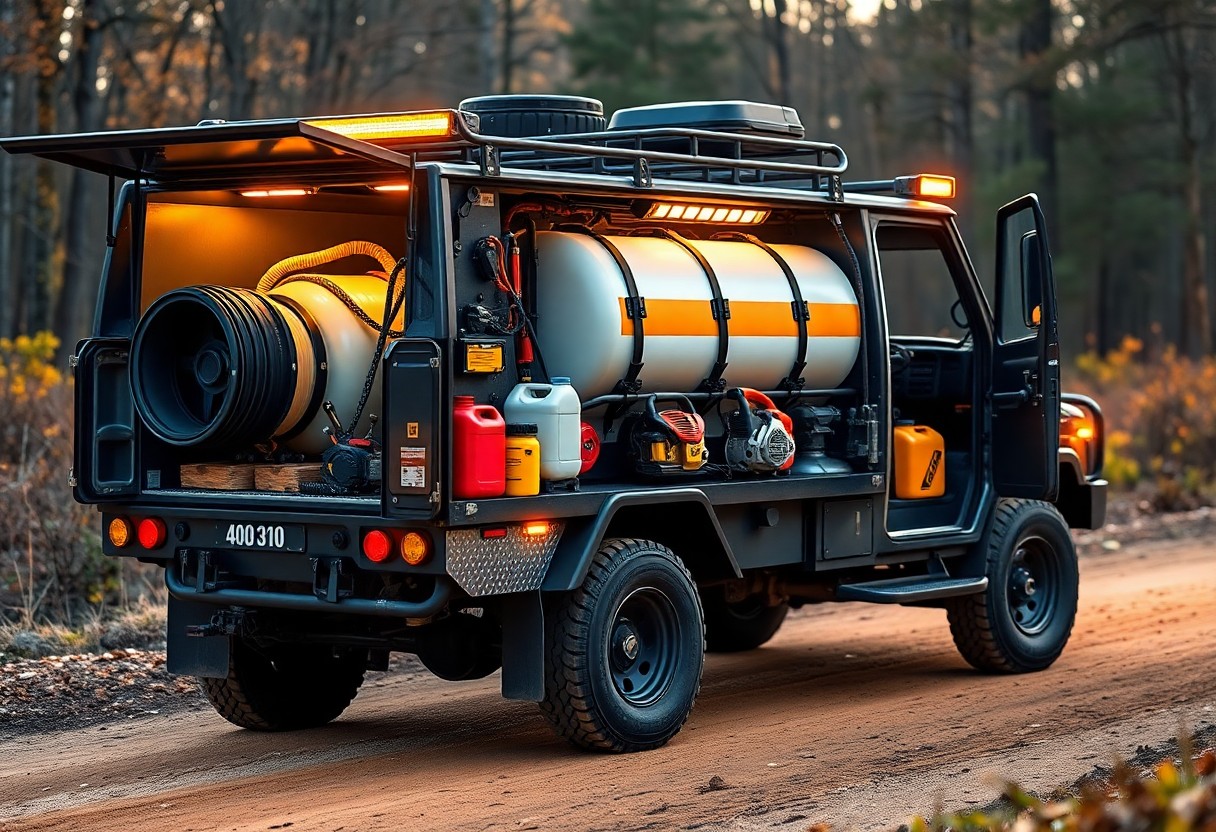
Specify a GVWR and payload margin that covers a 250-500 gallon water tank plus pump, hose reels and tools while leaving 1,500-3,000 lb of usable payload for crew and gear. Organize storage with slide‑out trays, external side compartments and dedicated reels so you access chainsaws, backpacks and med kits without unloading. Use aluminum or marine‑grade bodies, powder coating, epoxy primers, stainless fasteners and underbody coatings to protect against moisture, salts and brush abrasion.
Place heavy items low and centered over the axles to keep axle loads balanced and maintain steering and braking performance; locate the pump near the centerline and route hose reels for shortest, most direct deploy paths. You can design compartments by mission-rapid‑attack (hoses/nozzles), support (fuels/fluids), and tools (chainsaws/hand tools)-and specify shelf load ratings (500-1,000 lb) with tie‑downs and removable trays. Include drain ports and access panels for cleaning, and plan for annual touch‑up of coatings and fastener checks to extend service life.
Fire suppression systems
Your suppression system should balance pump capacity, foam capability and available water for extended rural operations. Use a mid-range centrifugal pump rated 250-500 gpm at 150-200 psi for sustained wildland work, or integrate CAFS to extend reach while conserving water. Include portable monitors flowing 50-300 gpm for structure protection and a 1-6% foam proportioner with Class A additives (0.1-0.5%) and Class B options (3%/6%) where fuels are present.
Pump specifications, hose reels, nozzles and foam capability
Select pumps that match your typical hose lays and relay needs: 250-500 gpm at 150-200 psi covers most brush responses, higher if you supply tenders. Fit hose reels with 1″-1.5″ preconnects (50-300 ft) plus 1.5″-2.5″ attack lines. Specify adjustable fog and straight-stream nozzles (flows roughly 10-200 gpm), and carry eductors or balanced-pressure proportioners; CAFS is a force multiplier for reach and knockdown with limited water.
Tank size, portable tanks/skid units and refill options
Tank sizing should match response distance and shuttle plans: many brush rigs run 300-1,000 gallon tanks, tenders 1,000-3,000 gallons. Skid units of 125-500 gallons mount on UTVs or pickups for off-road access, while folding portable tanks commonly span 500-2,000 gallons for shuttle operations. Plan refill methods-drafting, relay pumping or shuttle-and-dump-so you can refill at ponds, rural hydrants or designated dump sites efficiently.
Beyond capacity, match tank placement and baffling to off-road stability; a 500-gallon rear-mounted tank with internal baffles reduces surge on steep trails. Use camlock fittings and a 3″ dump to cut fill/dump times-at 500 gpm a 1,000-gallon tank fills in about two minutes when drafting or tender-supplied. Consider a 1,000-2,000 gallon portable bladder for prolonged incidents and carry spare 5-20 gallon cans for mop-up in tight, inaccessible spots.
Wildland tools & equipment
Hand tools, chainsaws, drip torches and portable pumps
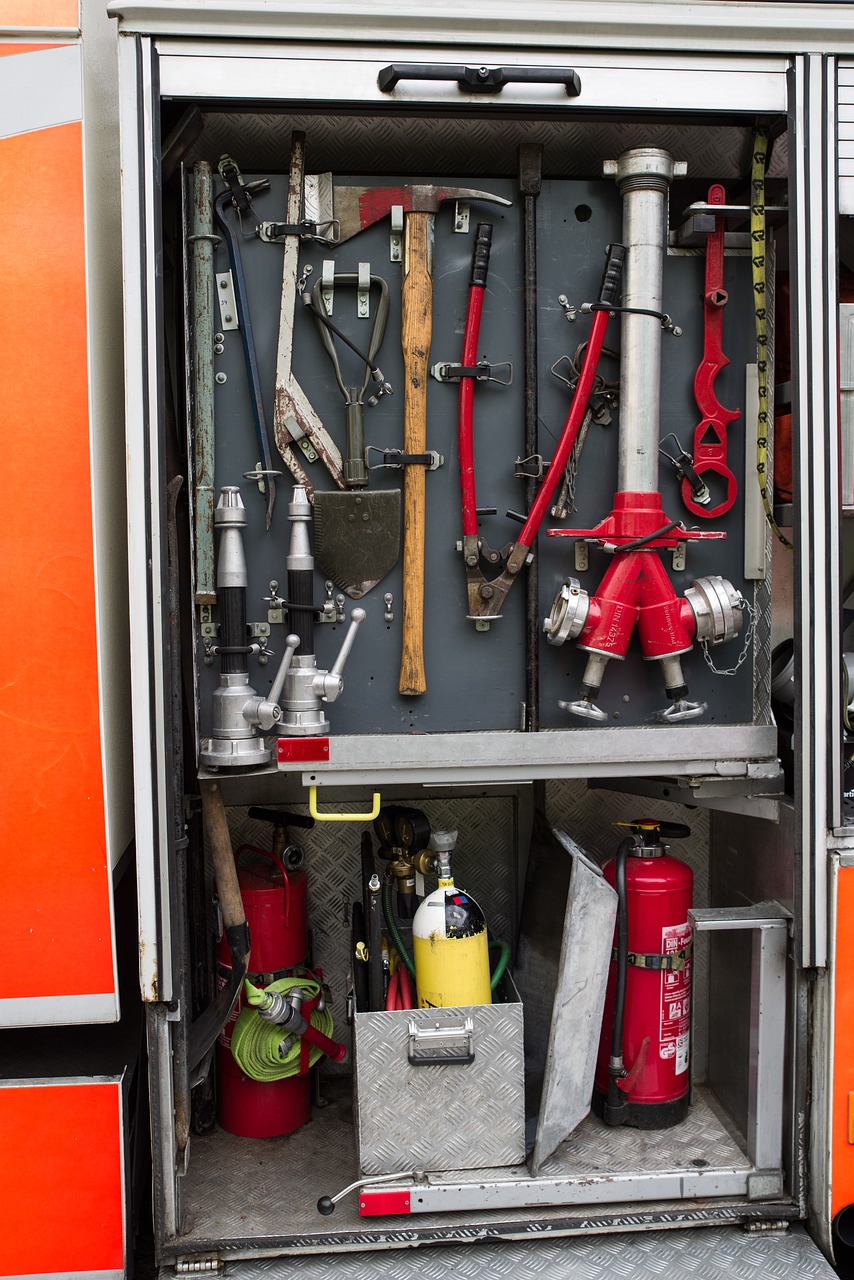
You should carry a minimum set of hand tools – Pulaski, McLeod, rake, shovel and hazel hoe – and a couple of handline shovels for mop-up. Use chainsaws with 16-20″ bars for brush and 18-24″ for small trees, keep spare chains and mixed fuel. Operate a drip torch on a 3:1 diesel-to-gasoline mix for controlled ignitions and bring 5-10 L spare cans. Include portable pumps rated 10-50 GPM with 1½-2″ discharges and 50-200′ of hose for hose lays and structure protection.
PPE, fire shelters, lighting and scene lighting
Your PPE should meet NFPA 1977 wildland standards: Nomex or aramid shirt and pants, a Type II helmet with shroud, leather gloves, and 8-10″ leather boots. Carry the issued fire shelter meeting interagency specs and inspect it before each shift. For lighting, pack headlamps (300-1,000 lumens), handheld LEDs (1,000-3,000 lumens) and a portable scene light (10,000-30,000 lumens) with spare batteries and a power bank.
You must train on fire shelter deployment annually and replace shelters after any damage or when service life limits are reached; agencies typically require documented shelter training each season. Inspect your Nomex for holes, exposed seams or oil contamination before every assignment and launder per manufacturer instructions to preserve flame resistance. Mount scene lights on stable poles or vehicles, aim low to reduce backscatter in smoke, and stage battery packs in waterproof cases; consider a 12V inverter or portable generator to run 20,000-50,000 lumen towers on extended incidents.

Communications & navigation
VHF/UHF radios, satellite/backhaul options and ICS integration
You should outfit the brush truck with VHF (low-band 30-50 MHz and high-band 150-174 MHz) and UHF (450-512 MHz) radios, plus a vehicle repeater and cross-band capability to extend range through valleys; line‑of‑sight VHF can reach 10-30 miles depending on terrain. Add satellite backhaul (Iridium for global reach, Inmarsat/BGAN or Starlink for higher throughput) and a FirstNet-capable cellular modem on Band 14 for priority data. Program ICS talkgroups (Command, Tactical, Logistics) and log net control/channel assignments into CAD/MDT for seamless ICS integration.
GPS, mapping, terrain awareness and vehicle tracking
You need rugged GNSS receivers, offline topo and satellite basemaps (ArcGIS Field Maps, Avenza, Gaia), and digital elevation models (USGS 10m DEM) for slope and aspect analysis; consumer GPS gives ~2-5 m accuracy while WAAS/RTK can get sub‑meter. Combine with AVL that reports every 30-60 seconds and geofencing alerts so dispatch knows vehicle location and approach vectors in complex terrain.
For deeper capability, add RTK-capable antennas or GNSS+GLONASS/BeiDou receivers to improve fix reliability under canopy and integrate ADS-B/aircraft traffic overlays when working near aircraft. Use hillshade and slope layers to flag areas over 30° and pre-plan safe anchor points and egress routes; store incident footprints and ingress tracks as GPX/KML for after-action review and wildfire mapping coordination with nearby agencies.
Crew safety, health & accountability
Embed LCES (lookouts, communications, escape routes, safety zones) into every assignment and equip your brush truck with a passport/tag accountability system plus GPS tracking for each member. You should run scheduled PAR checks-every 20-30 minutes during high-risk operations-log fitness/heat status before extended shifts, and carry scene lighting and backup radios to maintain crew location and condition even after nightfall.
Medical kits, hydration systems, heat/fitness monitoring
You should stock an advanced trauma pack: at least two tourniquets, hemostatic gauze, burn dressings, chest seals, SAM splint, airway adjuncts, pulse oximeter and a 2-4 L oxygen cylinder with BVM. Add hydration bladders (3 L per person), electrolyte drinks, and basic IV fluids if personnel are trained. Use wearable heart-rate or core-temp monitors and log readings each shift to detect heat strain early.
Escape routes, crew accountability systems and lighting
You must pre-plan primary and secondary escape routes allowing egress within 5-10 minutes by foot or vehicle, mark them in your GPS, and brief the crew. Implement a passport or RFID accountability system and enforce PAR checks every 20 minutes during active fire behavior. Carry helmet lights (300-1,000 lm), portable LED floods (2,000-8,000 lm) and spare batteries to preserve visibility for evacuations or night operations.
For more depth, outfit your truck with GPS trackers or personal beacons (Garmin inReach/Spot-type devices) configured to report positions every 2-10 minutes and tie them into your incident map. Mark escape routes with GPS waypoints, reflective tape or chemlights, and train crews to switch to an emergency radio channel if primary comms fail. Maintain lighting backups-headlamps, handhelds and a 6-12 hour portable flood-to ensure any 5-10 minute egress remains visible and verifiable during low-light evacuations.
Maintenance, logistics & interoperability
You should build maintenance and logistics around long distances and limited support: weekly walk‑arounds, monthly pump exercises, oil/filter changes every 5,000 miles or six months, and a full pump/service inspection every 100 operating hours or annually. Keep digital logs tied to VIN/pump serials, label spare kits for single‑tech repairs, and map resupply points (fuel, water, parts) for typical 20-50 mile response corridors so downtime stays minimal.
Preventive maintenance, spare parts and refueling/water resupply
You should carry a basic parts kit: belts, fuel and oil filters, pump seals, suction strainers, spare nozzles, hose clamps, fuses and a battery jump pack. Keep two 5‑gal (≈19 L) jerry cans for emergency refuel, maintain 150-500 gal onboard water (common brush truck range) plus at least one 250-1,000 gal portable drop tank and 100-300 ft of 3″ hose for shuttle ops. Log refills and part swaps weekly.
Mutual‑aid compatibility, documentation and training readiness
You should standardize couplings and comms: carry Storz and NST adapters to cover 1.5″, 1.75″, 2.5″ and 3″ connectors, publish pump curves and tank capacities on a placard, and program county mutual‑aid radio channels into every mobile and portable radio. Keep up‑to‑date apparatus inventories, SOP PDFs, and incident maps so responders from neighboring districts can integrate within ICS without delays.
You should exercise interoperability regularly: run monthly radio checks, conduct quarterly joint drills and at least one annual multi‑agency full‑scale exercise that validates hose adapters, supply caches and relay pumping. Share GIS preplans and a mutual‑aid equipment cache list ahead of season, adopt common labeling (type/pump gpm/tank gallons) and track training attendance and certifications so you can mobilize seamlessly under a single incident command.
Final Words
As a reminder, when covering large rural areas you should outfit your brush truck with a reliable water tank and pump, varied hose lengths and foam, hand tools (McLeods, Pulaskis), chainsaw, extra fuel and spare parts, robust PPE and a medical kit, strong communications and GPS, lighting, and transportable pumps or skid units, plus trained personnel to operate and maintain equipment.