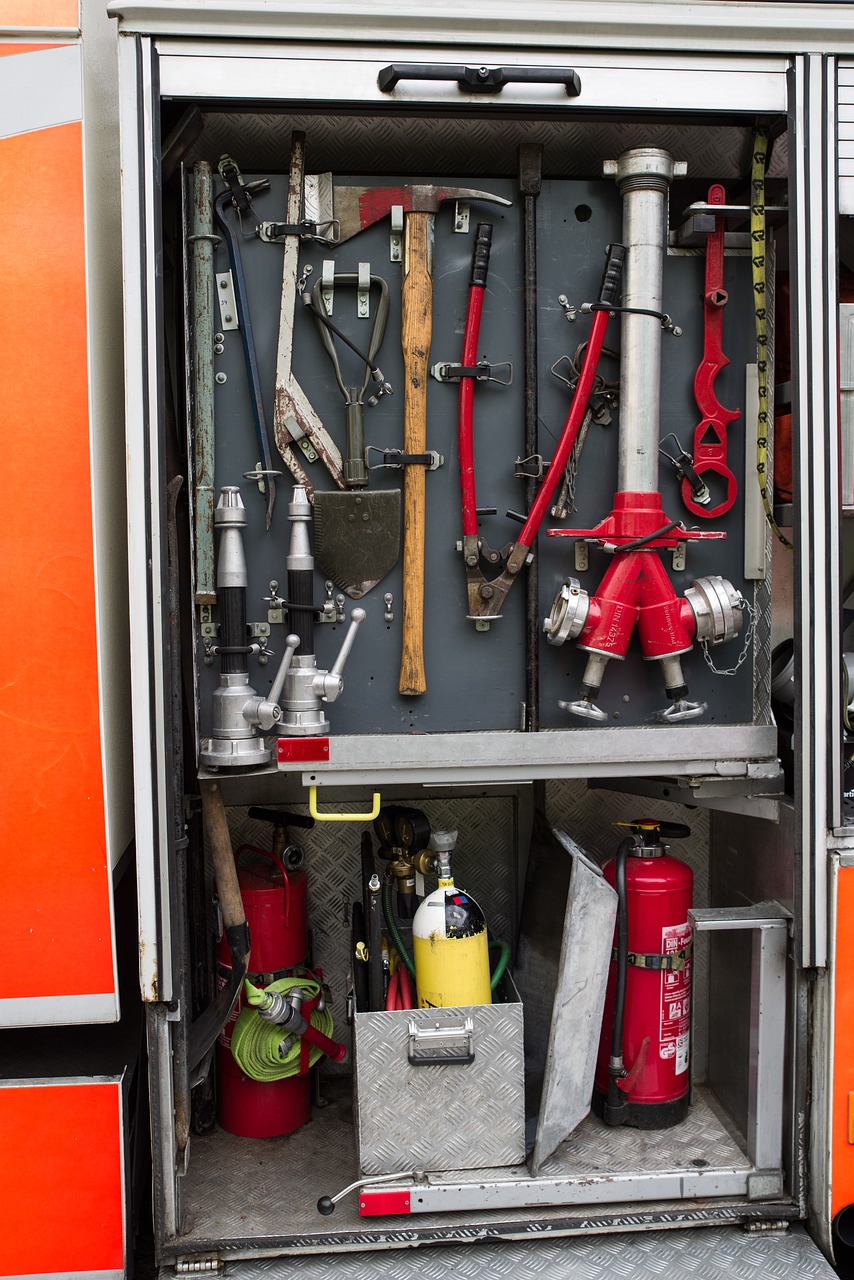
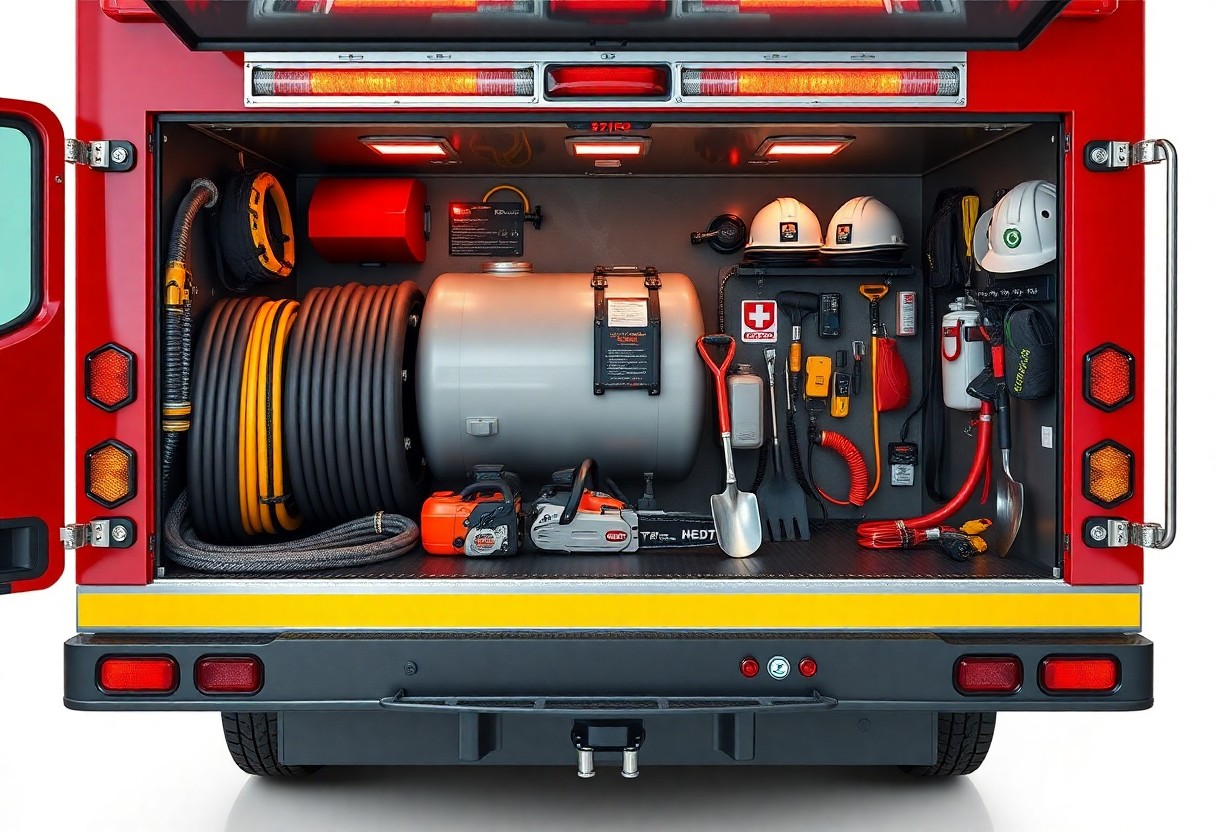
Brushtruck readiness demands a full complement: reliable water tank and pump, multiple hose lines and nozzles, chainsaws and hand tools, comprehensive PPE for each crew member, robust radios and GPS, spare fuel and batteries, a trauma medical kit, lighting and rigging gear, and clear incident documentation forms so you can respond safely and keep your team equipped for wildland operations.
Key Takeaways:
- Personal protective equipment and medical supplies: structured wildland PPE (Nomex/brush coats and pants), helmets, goggles/face shields, gloves, leather boots, fire shelters, hydration packs, on-board first-aid/trauma kit and AED.
- Fire suppression systems and tools: reliable pump and fittings with adequate GPM, water tank and portable pump options, hose reels and nozzles, hand tools (Pulaski, McLeod, shovels), chainsaw with spare chains/fuel, secure mounting and easy access to prevent injury.
- Communications, lighting and scene safety gear: multi-band radios with spare batteries/chargers, GPS/mapping or MDT, scene and vehicle lighting, traffic coning/scene control devices, thermal imager and basic maintenance supplies (fuel, oil, spare parts).
Fire suppression & water delivery
Your brush truck must deliver water and foam reliably under austere conditions: pumps in the 150-500 GPM range, 300-500 gallon tanks, pump-and-roll capability for mop-up at low speeds (~3-5 mph), and Storz or NST intakes for rapid mutual aid connections. You should have onboard drafting ability, power-take-off driven pumps for sustained output, and easily accessible gauges and relief valves so your crew can manage flow and pressure while working steep or irregular terrain.
Pump, tank capacity and fittings
Specify a pump sized to match response types-150-250 GPM for most single-engine attack brush trucks, up to 500 GPM for larger districts-paired with 300-500 gallon tanks to extend attack time. Include 2.5″ supply and 1.5″ discharge fittings, at least one 2.5″ Storz rapid-fill port, relief valves set per NFPA or local SOPs, and a separate hand pump or priming system for drafting from portable sources.
Hose lines, nozzles and foam systems
Stock both forestry hose (1″-1.5″, 100-300 ft rolls) for long reach and 1.5″-1.75″ attack lines for higher flow; carry at least one 2.5″ supply line for hydrants or tenders. Fit adjustable smooth-bore and variable-flow fog nozzles, plus an inline eductor or balanced-pressure proportioner for Class A (0.1%-0.5%) and Class B (1%-3%) foams. Consider a small CAFS or low-expansion foam setup to enhance knockdown and water distribution.
Manage hose with reels for quick deployment and loose rolls for rough ground; reels 200-300 ft with swivel connections speed single-operator tactics. Keep nozzle pressures clear-smooth-bore around 50 psi for maximum reach, fog around 100 psi for atomization-and store 20-50 gallon foam cells or portable jerry cans with secure mounting. Train on proportioner calibration and swapable nozzle jets so your crew adapts flow rates to fuel type and burn characteristics.
Crew protection & PPE
Wildland firefighting PPE (helmets, Nomex, boots, gloves)
Your brush truck should stock helmets with integrated eye protection and secure chin straps, Nomex or NFPA 1977-compliant shirts and pants, 8-10 inch leather lace-up boots meeting ASTM F2413 toe and puncture specs, and gauntlet-length leather gloves with heat-resistant reinforcement. Pack spare sizes, fire-resistant hoods, and replacement cuffs so you can swap gear between shifts and maintain layer integrity during extended incidents.
Respiratory protection, hydration and fire shelters
Keep SCBA on-board for structure or IDLH environments and stock NIOSH-approved particulate respirators (P100 or N95) for extended smoke exposures; you should know filters don’t protect against low-oxygen atmospheres or toxic gases. Carry individual 2-3 L hydration reservoirs and vehicle-mounted coolers for extra fluids. Store one fire shelter per firefighter in an easily reached, labeled compartment and run deployment drills quarterly.
OSHA/NIOSH require SCBA in IDLH conditions, so you should practice donning SCBA under timed drills (aim ≤60 seconds) and include low-visibility egress scenarios. For non-IDLH smoke, P100s remove >99.97% of particulates but won’t stop CO or VOCs, so use handheld CO monitors when smoke density rises. Plan hydration at 0.5-1 L per hour per firefighter, carry 2-4 L spares on the rig, provide electrolyte mixes, and inspect or replace fire shelters after any damage or when past the manufacturer’s service date.
Tools, cutting & power equipment
Hand tools (Pulaski, shovels, rakes)
You should carry a balanced set of Pulaskis, round-point and flat shovels, and McLeod or leaf rakes to outfit a crew of 4-6-typically 6-8 tools. Pulaskis with 36″ handles deliver leverage for fireline digging, while 24-30″ shovels and 48″ rakes speed mop-up and soil removal. Store heads protected and secure handles to prevent injury and tool damage in transit.
Chainsaws, brush saws and fuel/maintenance gear
You need at least one gas chainsaw with a 16-24″ bar plus a brush saw or cutter for light fuels and dense grass, along with spare chains, bar oil, and manufacturer-recommended 2‑cycle fuel (commonly 50:1 or 40:1). Carry PPE-chaps, helmet, eye and ear protection-approved fuel cans, a round file, bar wrench, spare spark plug and air-filter for field service.
You should store a primary saw and a backup-many departments use a 20″ primary and a 16″ for limbing-plus a 14-18″ brush-saw head for fine fuels. Perform pre-shift checks on chain tension, chain brake, bar oil and carburetor, and sharpen chains during extended cuts; keep a file guide, depth gauge, and a spark-arrestor screen on-hand. Secure saws in locked racks and label fuel containers to prevent cross-contamination.
Medical, rescue & casualty management
You should stock the brush truck to support immediate life-saving care and prolonged field stabilization: oxygen with a regulator and non-rebreather plus a 1- and 2-person BVM, AED, suction, pulse oximeter, and basic airway adjuncts. Include ALS-capable items if your agency protocols allow, and carry medication kits per local scope. Aim for redundancy – two oxygen masks, two BVMs – so you can treat multiple patients on multi-victim incidents.
Trauma and first-aid kits, patient packaging
Your trauma kits need tourniquets (at least two), hemostatic dressings (e.g., chitosan-based), chest seals, Israeli bandages, and multiple sizes of sterile dressings. Add SAM splints, cervical collars (adult/child), a long spine board and a vacuum mattress or straps for patient packaging. Keep a KED for seated extrications and trauma shears, plus clear labeling and replenishment checklists so you deploy intact kits under stress.
Extrication tools, stabilization and retrieval gear
Include a battery-powered cutter/spreader set, reciprocating saw, Halligan bar, bolt cutters, chainsaw for structural access, and heavy-duty pry bars. For stabilization carry adjustable struts, timber cribbing, ratchet straps and a set of rescue-rated webbing and carabiners. Add a Stokes basket, two rescue harnesses, 100 ft of static rope, pulleys and a 3:1 mechanical advantage pack for lifting or lowering casualties from steep or confined terrain.
Maintain hydraulic and battery tools per manufacturer intervals, log service dates, and perform monthly operational checks; ropes should be tagged with inspection and retirement dates. Train with your exact equipment – practicing a loaded Stokes raise, anchor builds and 3:1 hauling systems – and verify component load ratings before use so you can safely rig for specific loads and terrain during multi-patient or complex extrications.

Communications, navigation & lighting
Equip your truck so radios, navigation and lighting form a single system: vehicle-mounted P25-capable radios, an in-cab MDT with GPS, FirstNet/LTE backup, and 360° LED scene illumination. You should carry redundant comms (mobile + handhelds + portable hotspot), topo-capable mapping offline, and at least one telescoping light tower. This combination keeps your crew linked to command, oriented on rugged terrain and safe during night operations or multi-agency responses.
Mobile/portable radios, interop and incident tech
Install a 25-50W mobile radio (VHF/UHF, P25 Phase 1/2) and supply 2-4 handhelds (1-5W) with spare batteries so your crew always has a channel. Program mutual-aid talkgroups, enable AES where allowed, and add a vehicle router for FirstNet/priority LTE. You should also carry a compact portable repeater or cross-band adapter and use an MDT or tablet running incident-management software for resource tracking and digital ICS forms.
Scene lighting, work lights and GPS/mapping
Use LED flood arrays providing 10,000-40,000 lumens with a 20-30 ft telescoping tower for wide-area coverage, plus 2-4 portable battery floods (5,000-15,000 lumens) for task lighting. You want 360° illumination to reduce shadowing and an adjustable color temperature around 4000-5000K for accurate color rendering. Integrate GPS-enabled MDTs with offline topo and parcel layers so crews navigate remote roads and mark hazards directly from the apparatus.
Mount scene lights on articulating heads and place portable units to avoid backscatter into drivers’ eyes; engine-driven alternator power, a PTO-driven generator or high-capacity lithium battery packs each offer trade-offs in runtime (5-12+ hours). You should pick lights with flood and spot modes, quick-release mounts, and IP67 protection. For mapping, enable WAAS-corrected GPS (typical 1-3 m accuracy), pre-load evacuation routes and water sources, and sync tracks to command when LTE is available.
Safety systems, scene control & logistics
Integrated systems on the brush truck tie together lighting, comms and accountability so you can manage fast-moving incidents: mount 10,000-lumen LED scene lights, carry at least two portable radios per crew member with spare batteries, and use GPS/AVL to track resources. You should establish an ICP within 200 feet of the fireline and set a rehab area with hydration and a basic EMS kit. A visual tag board or RFID check-in reduces crew confusion during shift changes and multi-unit responses.
Traffic control, marking, PPE inspection and accountability
Deploy 28″ traffic cones, an LED arrow board, and reflective delineators to create a 50-75 foot buffer for safety; use ANSI/ISEA 107 Class 3 vests for all roadside personnel. You should run a quick PPE inspection checklist-helmets, gloves, Nomex, eye protection, and SCBA where used-before entry. Maintain a whiteboard or digital accountability system at the command post and perform PAR checks on scheduled intervals or after tactical transitions.
Spare parts, fuel, spill kits and maintenance tools
Carry at minimum 5 gallons of fuel in approved cans, two spare fan belts, an extra fuel filter, and a small parts kit (clamps, fittings, spark plugs). Your spill kit should include absorbent pads, booms, and disposal bags rated for at least 15 liters of hydrocarbon fluid. Include a 12V jump starter, portable air compressor, tire repair kit, grease gun, adjustable wrenches, and a compact battery of hand tools for field repairs.
Standardize inventory with labeled bins and a weekly checklist: keep two 5-gallon cans (gasoline and diesel if needed), three spare belts, four fuel filters, and ten hose clamps. Store spill materials in a single weatherproof box-20 absorbent pads, two booms, and 10 disposal bags-and rotate expiry-sensitive items every 12 months. Train your crew to perform a 15-minute walkaround at shift start that verifies fluid levels, tire pressure, and that each toolbox contains torque wrench, pliers, a spark plug socket, and a filter wrench.

Conclusion
With this in mind you should outfit your brush truck with reliable wildland PPE, radios and GPS, water and pump systems, hand tools, medical supplies, lighting, spare fuel, and a secure storage system so you can respond quickly, stay connected, treat injuries, and work safely in rugged terrain.