You build onboarding checklists that protect new recruits and streamline operations by mapping life‑saving safety protocols, task‑based training milestones, and clear administrative steps; you prioritize safety and risk mitigation while defining roles, timelines, and evaluation criteria so volunteers reach operational readiness quickly, improving retention and team confidence and ensuring consistent compliance with standards.
Key Takeaways:
- Define clear goals and measurable milestones for each phase of onboarding, including required certifications and competency checks.
- Organize the checklist into consistent sections (administrative, safety, equipment, training, communications) for quick reference.
- Assign ownership and deadlines for each item so supervisors know who signs off and when tasks must be completed.
- Provide both digital and printable versions, keep version control, and update the checklist based on after-action feedback.
- Pair checklist completion with hands-on mentoring, ride‑alongs, and practical evaluations to confirm real-world readiness.
Importance of Onboarding in Volunteer Fire Departments
Well-structured onboarding shortens the time it takes for a recruit to become operational by giving you a clear sequence of tasks: complete PPE and SCBA fit testing, finish Firefighter I classroom and skills benchmarks (commonly targeted within 6-12 months), ride on apparatus for a set number of calls, and pass a signed probation checklist. Departments that adopt formal checklists and milestone tracking typically see faster integration and fewer preventable mistakes on scene because every new member knows which tasks take priority and who signs off on competency.
You should measure onboarding success with specific metrics-time-to-first-run, percentage of probationary members who complete core skills within 90 days, and incident-related safety events during the first year. Use those numbers to justify resources: for example, tracking a drop in first-year safety incidents or an increase in training completion rates often makes it easier to secure training hours, PPE replacements, or stipend funding.
Enhancing Recruitment and Retention
Offer a transparent pathway from recruit to active responder: list required certifications, target timelines (probation frequently lasts 6-12 months), and mentorship arrangements such as a 1:3 mentor-to-recruit ratio so expectations are clear from day one. You can leverage onboarding as a recruiting tool by publishing a sample checklist and timeline on your recruitment materials-prospective volunteers respond to concrete commitments like guaranteed ride-alongs within 30 days or scheduled training blocks totaling 24-40 hours in the first three months.
Keep volunteers engaged by tying onboarding milestones to recognition and incremental responsibility: grant radio privileges, apparatus access, or limited single-company assignments after specific sign-offs. Track retention with simple indicators-percent of recruits retained at 6 and 12 months, and the rate who complete probation-and use that data to tweak your onboarding length, mentorship intensity, or scheduling flexibility (for example, offering two 12-hour weekend commitments as an option to accommodate work schedules).
Establishing a Safe and Prepared Environment
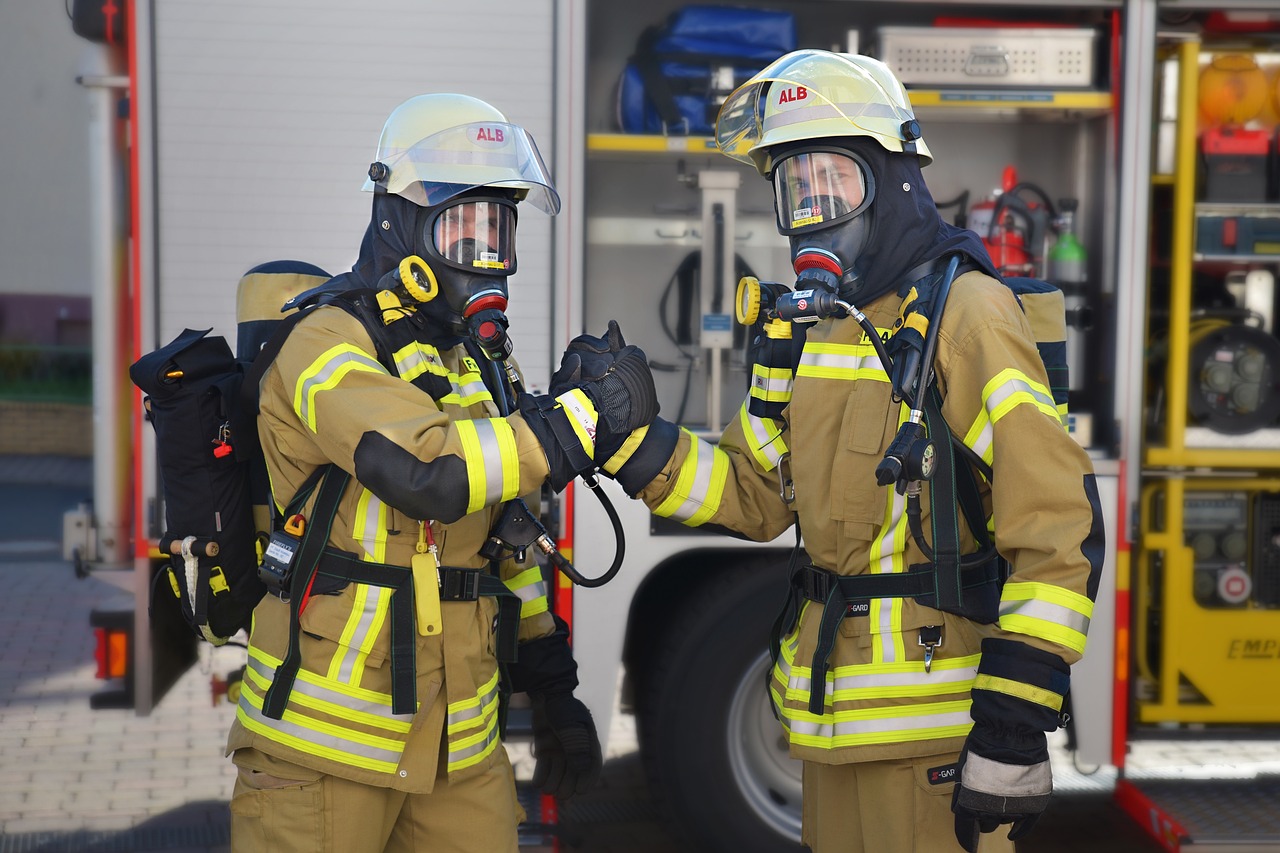
Begin onboarding with safety-first checklists: formal PPE inspection procedures, annual SCBA fit testing per OSHA 29 CFR 1910.134, and a station familiarization walkthrough that covers seatbelt policy, jump-seat assignments, and equipment stowage. Emphasize high‑risk items-improper SCBA use, unsecured tools, and bypassed seatbelts-as these are common contributors to line-of-duty injuries; have recruits demonstrate donning/doffing and a pre‑shift apparatus check before any response duties.
Integrate measurable training frequencies into the checklist: weekly or monthly drills with documented objectives, quarterly live‑fire or hands‑on evolutions under NFPA 1403 guidance, and skills sign-offs recorded on individual competency sheets. Use a simple audit-percent of members current on fit testing, PPE inventory status, and number of safety drills logged per quarter-to spot gaps and prioritize corrective training or repairs.
Also include post‑incident processes in onboarding: mandatory after-action debriefs, exposure reporting, and mental‑health check-ins following traumatic calls. Provide the hepatitis B vaccine offer and bloodborne pathogen training per OSHA 29 CFR 1910.1030, keep exposure logs, and ensure you have a clear timeline for medical follow-up so new members know how incidents and exposures will be handled.
Key Elements of an Effective Onboarding Checklist
Break the checklist into functional sections-administration, training, safety/equipment, and mentorship-so you can track progress at a glance. Use measurable milestones such as a 30‑day orientation, a 90‑day operational readiness review, and a 12‑month certification goal; for example, many departments require completion of Firefighter I (or equivalent) within 12 months and documentation of at least 40 hours of station training before independent responses.
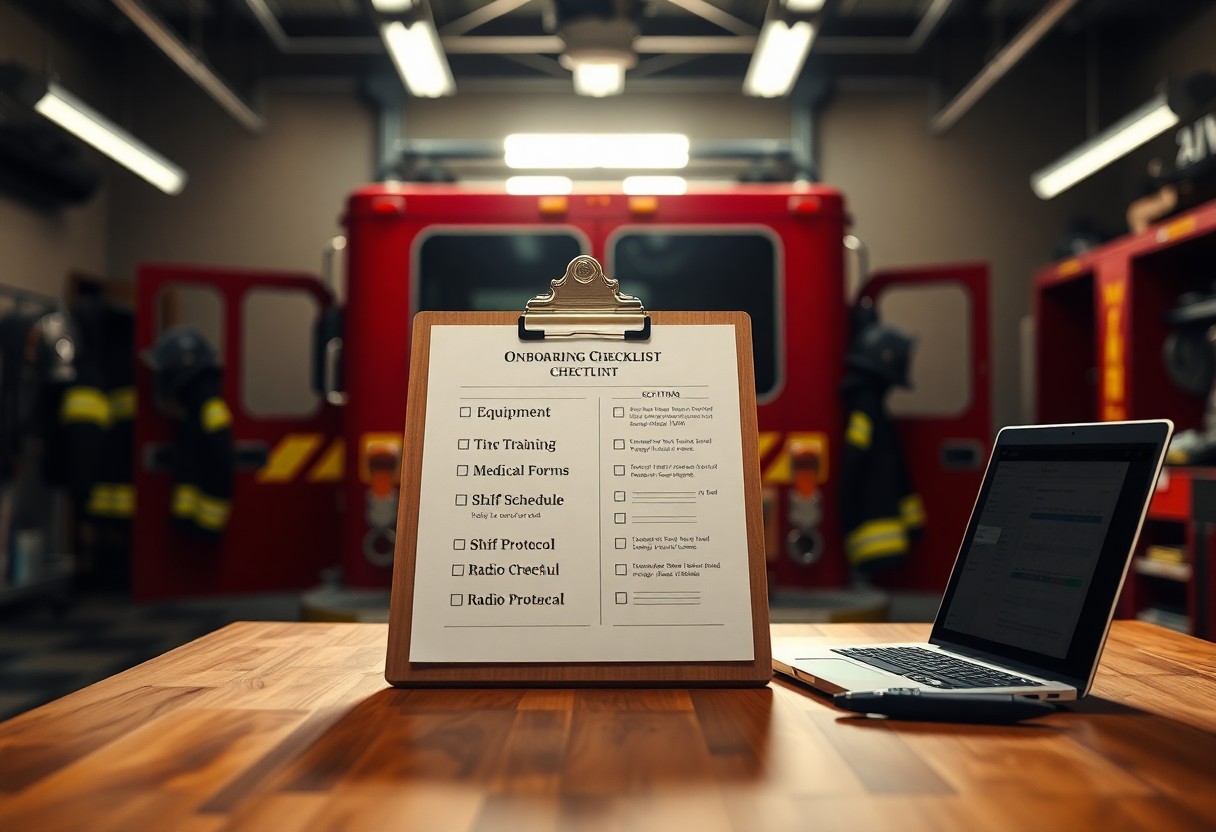
Assign responsible parties and deadlines for each item and include sign‑off fields for both the recruit and the officer who verified competency. Departments that use digital checklists report faster verification and fewer missed items-aim to capture dates, instructor names, and evidence (photos, PDFs) for each completed step so your audit trail is complete and defensible.
Administrative Paperwork and Documentation
Collect initial forms on day one: application, volunteer agreement, tax forms (W‑4), employment eligibility (I‑9) or state equivalent, and signed standard operating guidelines (SOG) acknowledgment. Require written consent for background checks and a current driving record if the recruit will operate apparatus; many departments deny driving privileges without a clean abstract or completion of a driver training course.
Make medical clearance and immunization status non‑negotiable items-require a physician release or occupational health screening, documentation of tetanus, and either Hepatitis B vaccination series or a signed declination form. Flag any medical limitations in the recruit’s file and ensure PPE sizing and asset issue forms are signed; missing or incomplete medical documentation is a common cause of liability, so mark these items as high priority.
Training Requirements and Resources
List required core trainings with target timeframes: station orientation and ride‑alongs within the first 30 days, SCBA facepiece fit test and PPE issue within 14 days, and correspondence or classroom completion of Firefighter I (typically ~150-200 training hours depending on your state) within 12 months. Include EMS certification requirements (EMT‑Basic often 120-200 hours) when applicable, and specify which courses your department will sponsor versus those the recruit must obtain independently.
Embed links or contact details for local training academies, volunteer firefighter state programs, and online resources, and note mandatory refresher intervals-annual SCBA fit testing and periodic live‑fire competency under NFPA 1403 supervision are common expectations. Also schedule regular skills sign‑offs: hose handling, ladder raises, and patient packaging should be verified by a qualified officer before operational status is granted.
For practical implementation, include exact checklist items such as: SCBA fit test completed within 30 days; PPE issued and inventory signed; at least 6 ride‑alongs and 8 documented station drills in the first 90 days; driver/operator training completed within 6 months if applicable; and documented Firefighter I progress or exemption paperwork in the 12‑month folder-these concrete targets make it straightforward for you to track readiness and compliance.
Steps for Developing Your Onboarding Checklist
Start by mapping the timeline into clear phases-orientation (first 7-14 days), core skills (first 30-90 days), and role qualification (3-12 months)-and assign measurable milestones for each phase. For example, require completion of a PPE inspection drill and SCBA fit test within the first week, a minimum of 10 supervised training evolutions and 5 ride‑along emergency responses before allowing independent interior assignments, and target NFPA 1001 Firefighter I competencies within 6-12 months for interior roles. Build the checklist so each item has a responsible party, an expected completion window, and a sign‑off field for competency verification.
Next, embed audit and feedback loops into the checklist workflow: perform a formal review after 30, 90, and 180 days, store sign‑offs in the personnel file or a digital LMS, and require the safety officer to vet any items involving live‑fire, confined‑space, or vehicle extrication before they’re released for unsupervised practice. Use quantitative progress metrics-percent of milestones completed, number of supervised calls, skills pass/fail rates-to spot training gaps and update the checklist quarterly based on after‑action reviews and changing department needs.
Involving Veteran Members in the Process
You should engage veteran members as subject‑matter experts to draft, field‑test, and validate checklist items because they can identify the most dangerous tasks that need supervised progression and realistic performance standards. Pair each recruit with a veteran mentor for a defined period (commonly 60-90 days or the first 10-15 shifts), require the mentor to document at least 10 supervised evolutions, and make mentor sign‑offs mandatory before any unsupervised assignment. That structure ensures practical, experience‑based criteria-like how many interior hose‑line evolutions or pump operations are acceptable-are grounded in local apparatus, terrain, and call volume.
Also set up a small review board of rotating veteran members to audit checklists twice a year and collect front‑line feedback after major incidents or trainings. Provide mentors with brief training on adult learning and objective assessment techniques, and recognize their role formally (award points toward service credits, certificates, or public acknowledgment) to reduce burnout and maintain high‑quality mentorship.
Customizing Checklists for Different Roles
Segment checklists into a universal core plus role‑specific modules so you avoid one‑size‑fits‑all traps: the core covers PPE, radio procedures, scene safety, and basic medical/CPR, while modules target interior firefighter, pump/operator, EMS responder, apparatus driver, and officer duties. For example, an interior firefighter module should include SCBA confidence drills, 10 supervised interior evolutions, and a live‑fire evolution under controlled conditions; a pump operator module should list pump panel familiarization, pressure chart exercises, and 5 supervised pump evolutions; an EMS module should require NREMT or equivalent verification, 20 documented patient contacts within 6 months, and advanced airway practice. Flag items involving live‑fire, high‑pressure pump operations, or vehicle extrication as requiring dual sign‑off by a mentor and the training officer.
Design checklists to scale with experience: use a three‑tier approach (probationary, qualified, advanced) where the probationary checklist contains 15-25 baseline tasks, the qualified tier adds 8-12 role items, and the advanced tier focuses on leadership and specialty skills. Schedule recurring re‑evaluations-annual recertification for pump operators, semi‑annual tabletop incident command drills for officers, and monthly skill stations for interior teams-to ensure competencies remain current and the checklist adapts to new equipment or protocols.
Template detail helps implementation: for a pump operator, include pre‑shift apparatus inspection (20 checkpoints), 8 hours of formal pump school, 10 supervised evolutions on two different apparatus types, and a documented solo pump operation signed by the training officer; for an EMS responder, require initial NREMT certification, 12‑lead ECG competency, a minimum of 20 patient contacts or simulations in 6 months, and quarterly case reviews. Make high‑risk items explicitly non‑waivable and require evidence (photos, LMS entries, or witness signatures) for each sign‑off to maintain accountability and auditability.
Implementing the Onboarding Checklist
Start by assigning a single onboarding lead who owns the checklist and schedules milestones: aim to complete administrative items (I-9, background check, medical clearance) within 7-14 days, station familiarization and PPE fit within 14-30 days, and initial live-skill competency checks by 30-60 days. You should integrate the checklist into your SOPs so supervisors know when a recruit is cleared for independent responses; for example, require NFPA 1001 Level 1-aligned skill sign-offs or equivalent department competencies before a recruit rides alone.
Use both digital and physical copies: a cloud-based checklist with date/time stamps plus a laminated station copy works best for redundancy. One mid-size department reduced paperwork errors by ~60% and shortened time-to-operational by ~40% after moving to an electronic sign-off system with automatic reminders, so track progress with simple KPIs (percent complete, average days to skill sign-off) and review them monthly.
Orientation Sessions and Training Workshops
Schedule an initial orientation inside the first 72 hours to 7 days, combining a 2-hour classroom on policies, radio procedure, and chain-of-command with a 2-4 hour hands-on tour of apparatus and PPE inspection. You should keep instructor-to-trainee ratios low-ideally 1:4-so each recruit gets supervised time on SCBA donning, hose deployment, and vehicle safety checks; live-fire drills must only occur with certified instructors and a controlled burn training site.
Follow orientation with targeted workshops across the first 30-90 days: plan discrete skill stations (e.g., ladder raises, forcible entry basics, victim drags) that each have a short written checklist and a pass/fail competency sign-off. Many departments require completion of 8-12 core skill stations and at least 10 supervised responses before moving to the next onboarding phase; tie those numbers to your checklist so both recruits and mentors know the specific milestones.
Monitoring and Feedback Mechanisms
Implement structured monitoring: weekly mentor check-ins, a digital progress dashboard showing completed items, and formal probation reviews at 30, 60, and 90 days. You should capture three metrics at minimum-percent checklist complete, number of supervised responses, and competency pass rate-and set operational thresholds (for example, 80% checklist completion and a “meets expectations” score on core skills) before independent duties are granted.
Build a feedback loop that combines immediate debriefs after calls, mentor evaluations, and anonymous surveys at the 30- and 90-day marks. When multiple recruits flag the same gap-radio proficiency or apparatus familiarization-use that data to create a short refresher module and update the checklist quarterly so onboarding evolves with real training needs.
For practical use, create standardized forms: a mentor feedback sheet with date, skill name, numeric rating (1-5), pass/fail checkbox, and mentor signature; a remediation plan template with clear tasks and a 4-week timeline for re-evaluation; and a simple dashboard showing time-to-first-independent-response and cumulative competency rates. You should review these monitoring outputs monthly and act on trends-if a core skill fails the cohort average, schedule a focused workshop within two weeks to mitigate any safety risk before recruits respond independently.
Evaluating the Onboarding Process
Measure onboarding outcomes with specific, repeatable metrics: time-to-certification (days from orientation to first NFPA-required credential), module completion rate, skills assessment pass rate, and retention at 30, 90, and 180 days. You should run checklist audits after every cohort and compare against benchmarks – for example, if your live-fire skills pass rate drops below 85%, treat that as a safety signal and investigate training fidelity immediately. Schedule formal reviews every 30 and 90 days so adjustments are data-driven rather than anecdotal.
Correlate qualitative observations with quantitative data by logging ride-along evaluations, simulation scores, and near-miss reports alongside checklist completion records. When one small-town department tracked these metrics, they reduced orientation gaps by 35% within six months after introducing monthly debriefs and skill rechecks; use similar short cycles to validate changes before broad rollout.
Gathering Feedback from New Volunteers
Deploy short, timed surveys at 7, 30, and 90 days that mix Likert-scale questions (e.g., “How confident are you performing hose lay: 1-5”) with two open-ended prompts about confusing steps and safety concerns. Aim for a response rate of at least 60% by keeping surveys under five minutes and offering anonymous options so volunteers report PPE fit issues or unaddressed safety gaps without hesitation.
Combine surveys with structured interviews and one-on-one mentorship check-ins to catch details surveys miss-ask specifically about checklist clarity, training cadence, and equipment access. If you receive repeated comments that a procedure isn’t covered in hands-on drills, log it as a priority item and tag the affected checklist item with a status (e.g., “Needs Hands‑On”) so you can track remediation.
Making Continuous Improvements
Use a simple PDCA (Plan‑Do‑Check‑Act) loop: prioritize feedback into a backlog, pilot changes with one shift or station, and measure impact for at least one full onboarding cycle (typically 30-90 days). Assign a single owner for each change and record outcomes – for instance, reducing checklist complexity by 20% in a pilot led to a 30% increase in completion rates and faster competency signoffs.
Document every revision in a change log that includes rationale, owner, implementation date, and target metrics; share summaries at quarterly training meetings so best practices spread across stations. When safety-related issues surface, escalate them immediately to leadership and schedule targeted retraining within 14 days to prevent recurrence of the same hazard.
To operationalize continuous improvement, maintain a prioritized action list with SMART goals (specific, measurable, achievable, relevant, time‑bound), run A/B pilots for larger changes, and require a minimum three‑month measurement window before full adoption; this disciplined approach helps you balance responsiveness with evidence so changes reliably improve safety and retention.
Conclusion
Now you can consolidate best practices into a clear, role-based onboarding checklist that outlines required certifications, necessary skills, equipment familiarization, operational procedures, and safety protocols. By breaking tasks into measurable milestones, scheduling hands-on training, assigning mentors, and documenting expectations, you ensure new volunteers achieve competency efficiently and align with department standards.
You should test and refine your checklists using feedback from trainees and seasoned personnel, track completion and performance metrics, and update items as policies, equipment, or community needs evolve. With consistent application and regular review, your onboarding process will strengthen retention, boost confidence, and improve overall readiness for emergency response.