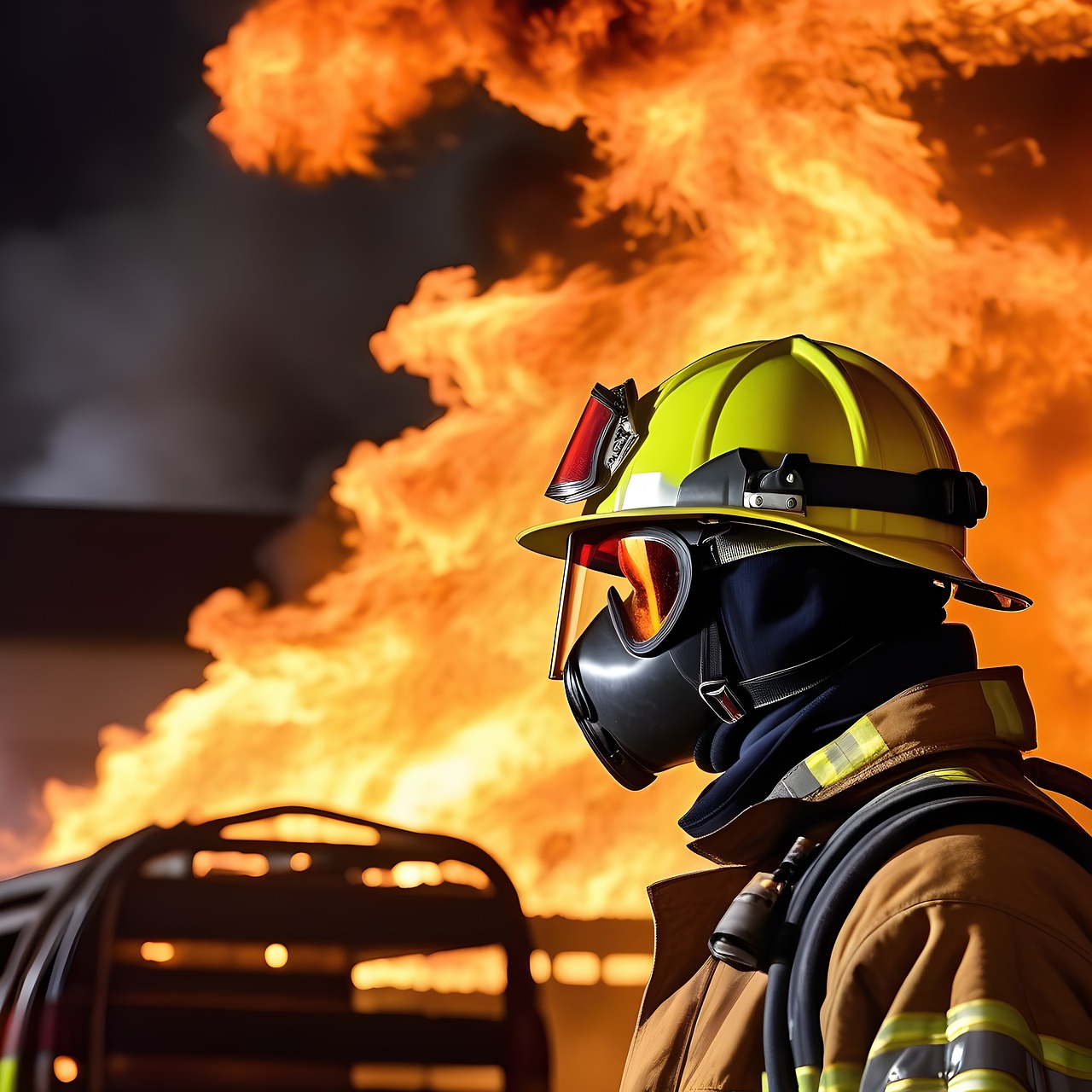
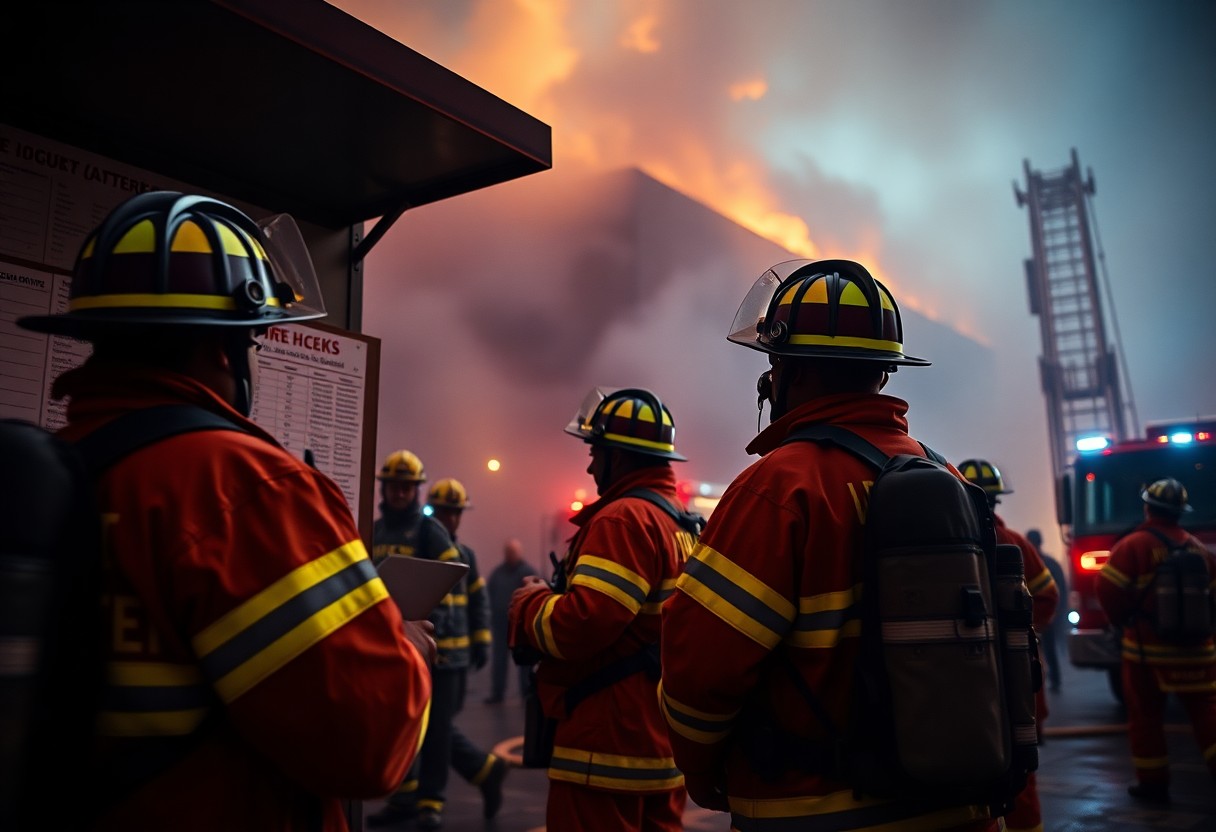
Firefighting multi-unit incidents require you to conduct rapid PAR checks, assign accountability officers, enforce radio discipline, verify crew locations, and document changes to maintain safety and command.
Key Factors Influencing PAR Efficiency in Complex Scenes
Assessing visual complexity, crew dispersion, lighting, and smoke patterns helps you prioritize PAR routes. Thou must assign clear sectors and a single PAR leader.
- Visual complexity
- Crew dispersion
- Lighting and smoke
Personnel Density and Structural Layout
Density affects how you sweep zones; tight clusters require smaller search teams, clear staging, and concise tracking to avoid missed personnel.
Communication Infrastructure and Signal Strength
Signals determine whether remote crews can confirm PARs; you should test radios, use redundancies, and preassign alternate channels.
Confirm that you map expected radio dead zones and structural signal blocks during briefing so you can place repeaters, assign runners, or shift channels; you should standardize ICS channels, equip sector leaders with boosters, and log contact failures for immediate reassignment.
How-To Implement a Tiered Accountability Structure
Implementing a tiered accountability structure lets you assign clear reporting lines during multi-unit incidents, reducing confusion and accelerating PAR completion for faster safety decisions.
Assigning Division Supervisors for Localized Roll Calls
Designate division supervisors to conduct localized roll calls, so you can track crew locations and statuses quickly while minimizing radio congestion and preserving command focus.
Coordinating Data Flow to the Incident Command Post
Channel PAR information from division supervisors through an assigned accountability officer to the ICP, allowing you to receive concise, actionable updates and adjust resources promptly.
Standardize your reporting templates and radio brevity so you can aggregate PARs rapidly, spot discrepancies, and route clear summaries to command. Use a single data path-division supervisor to accountability officer to ICP-and set fixed check-in intervals to confirm reconciliations and initiate targeted searches when personnel remain unaccounted for.
Tips for Maintaining Radio Discipline During High-Stress Events
Practice concise radio calls so you reduce channel congestion and speed PAR completion. Assume that you limit transmissions to safety updates, unit status, and PAR confirmations while delegating nonimperative messages.
- Use plain, concise language you can quickly read
- Reserve the channel for safety, PAR, and urgent tactical changes
- Designate a communications officer to filter routine traffic
Minimizing Non-Essential Transmissions
Limit non-imperative chatter by queuing informational updates and using preassigned reporting windows so you only transmit when it affects safety or PAR status.
Adopting Standardized Affirmative and Negative Responses
Adopt short, standardized replies like “Affirmative,” “Negative,” and “Copy” to remove ambiguity and accelerate acknowledgments; you must use only approved terms on the incident channel.
Train crews with drills that force single-word acknowledgments, practice using status tags (e.g., “Engine 2-Affirmative-All accounted”), and run timed PAR exercises so you build muscle memory and ensure faster, more reliable accountability during incidents.
Factors for Determining PAR Frequency and Timing
Weather, building layout, occupancy, tactical complexity, and crew fatigue determine PAR cadence; you must tailor checks to risk and resource status.
- Weather
- Layout
- Occupancy
- Complexity
- Fatigue
After you assess these factors, set PAR intervals and triggers to match incident tempo.
Monitoring Tactical Benchmarks and Changing Conditions
Monitor established tactical benchmarks and evolving hazards, and run PARs when objectives shift, crews rotate, or exposures increase; you should align checks with task completion points and risk escalation.
Recognizing the Impact of Transitioning to Defensive Operations
Recognize that when you transition to defensive operations, PAR intervals often lengthen while accountability shifts to perimeter teams, requiring consolidated staging, clear control points, and revised check triggers.
When you move to defensive tactics, tighten accountability: assign a perimeter accountability officer, consolidate crews into identifiable groups, update radio protocols, and reposition rapid intervention crews for access. You should schedule PARs after major position changes, wind shifts, or collapse indicators to catch delayed status changes and reduce exposure gaps.
How-To Utilize Modern Technology for Real-Time Tracking
Tech tools give you live status of crews, simplifying PAR checks during multi-unit incidents. Configure dashboards and alerts to show assignments, entry/exit times, and expirations so you can act on missing or overdue personnel immediately.
Integrating Digital Personnel Accountability Systems
You configure badge scans and mobile check-ins so the system maintains current rosters, assigns status, and produces instant PAR reports that you can trust during fast-moving incidents.
Using GPS-Enabled Radios for Automated Location Verification
GPS-enabled radios stream location data so you can verify unit positions automatically and reduce manual roll calls during multi-unit responses.
When you deploy GPS-enabled radios, set geofences for staging, entry points, and hazard zones, configure location update intervals to balance battery life and accuracy, and train crews on device placement. Combine radio feeds with incident mapping so you can cross-reference team tracks, detect deviations, and initiate targeted searches promptly.
Conclusion
So you maintain accountability during multi-unit fires by assigning clear sector PAR leaders, using concise radio reports, confirming locations and status verbally, and updating a centralized board rapidly so missing crews are identified and reassigned without delay.
FAQ
Q: What is a PAR and when should a PAR check be initiated during multi-unit fire incidents?
A: PAR (Personnel Accountability Report) is a rapid roll-call to confirm the location and status of all assigned personnel during an incident. Triggers for a PAR include a sudden event (collapse, explosion, flashover), a Mayday or report of a missing firefighter, a change from offensive to defensive operations, transfer of command, or command-directed accountability checks. The Incident Commander or a designated Accountability Officer issues the PAR order and specifies the scope (division, sector, or all units) and a response method. Typical steps: 1) IC announces PAR on the tactical channel and names the scope; 2) company officers report using a short standardized format (company ID, number of personnel on scene, location, status, and any missing members); 3) Accountability Officer logs responses against the roster or passport system and flags discrepancies; 4) if a unit fails to respond or reports missing personnel, IC confirms last known location, deploys the Rapid Intervention Crew (RIC) and search resources, and updates command priorities; 5) IC declares PAR complete and documents time and findings. Radio example: “Command to all units – PAR for Division 3. Report company, personnel count, location, and status.”
Q: How should accountability and communications be organized to make PAR checks efficient across multiple companies and divisions?
A: Assign a single Accountability Officer early and keep that role dedicated to tracking PAR status and maintaining the accountability board or electronic roster. Assign company officers to report for their crews and division/sector supervisors to consolidate reports from subordinate companies. Use a single tactical channel for PAR traffic and require concise, prebriefed response format to minimize radio congestion. Use physical or electronic tools such as passports/tags, status boards, or an electronic accountability system to reconcile responses in real time. For large incidents, split PARs by division or sector and stagger calls so each supervisor reports up one consolidated reply. Establish a backup method for communications failure: face-to-face report to the Accountability Officer, runners, or posting to a centralized whiteboard. Record time-stamped responses and attach them to incident documentation for after-action review. Radio phrasing model: “Engine 12, Division 3 – Engine 12, three personnel, operating at A-side, all accounted.”
Q: What common problems occur during PAR checks and what immediate actions should be taken if personnel are unaccounted for?
A: Common problems include radio congestion and missed calls, duplicate or inconsistent reporting, split crews that create roster mismatches, and delayed reconciliation of responses. Mitigation measures: keep PAR format simple and rehearsed, limit PAR traffic to one channel, assign accountability staff to reconcile and cross-check rosters, and perform periodic spot PARs rather than continuous scatter calls. If personnel are unaccounted for, follow these immediate steps: 1) confirm the last known location and assignment; 2) activate RIC(s) and task them with an immediate search; 3) order a withdrawal or hold interior operations if fire conditions endanger search or rescue; 4) assign additional search teams and track their progress; 5) notify division supervisors and update the IC frequently; 6) document actions and timestamps. After resolution, conduct a short accountability debrief to capture lessons and update procedures.