Training your volunteer firefighters in PAR check best practices ensures you maintain accountability, standardize procedures, and improve crew safety through clear roles, reliable communication, and regular drills you can adopt immediately.
Essential Factors for Effective Personnel Accountability
- Standardized ID tags and tracking
- Regular PAR intervals and role checks
- Clear radio protocols and repeat-backs
- Pre-briefs and realistic drills
You standardize ID tags, check-in cadence, role assignments, and radio protocols so every assignment is tracked. Assume that drills become routine and accountability becomes instinct.
Impact of Environmental Stressors on Communication
Smoke, noise, and heat degrade your radio clarity and verbal cues, so you verify messages with concise, repeat-back confirmations and redundant signaling.
Importance of Crew Integrity and Unity of Command
Command clarity keeps you aligned; follow the assigned leader, report deviations immediately, and maintain position awareness to protect the crew.
Maintain crew integrity by enforcing role discipline, running pre-shift briefings, rehearsing leader succession, and practicing PAR drills under simulated stress so you preserve trust, reduce hesitation, and speed coordinated rescues.
How-To Develop a Comprehensive PAR Training Curriculum
Design a curriculum so you sequence PAR basics, scenario practice, and assessments with clear objectives, measurable outcomes, refresher intervals, and documented checklists for volunteer progression.
Establishing Standard Operating Procedures for Volunteers
Create clear SOPs that define volunteer roles, PAR procedures, radio reporting, and escalation steps so you and your team follow one consistent method during incidents.
Integrating Accountability into Basic Skills Training
Embed PAR tasks into hose handling, search, and RIT drills so you practice accountability as an integrated habit rather than an add-on.
During drills, make PAR checks a required step: you must run timed roll calls, radio confirmations, gear-tag verification, and immediate status updates within hose, search, and ladder exercises. You assign instructors to score adherence using short checklists and to provide corrective coaching on the spot. Assign graded scenarios with simulated casualties or entrapment so you can assess performance under stress. Use training logs and simple metrics to track proficiency, schedule targeted refreshers, and document when volunteers meet operational standards.
Mastering Radio Discipline and Communication Protocols
Your radio discipline keeps crews accountable during PAR checks by enforcing concise call signs, brief status responses, and mandated repeat-backs to eliminate ambiguity and accelerate accountability.
Implementing Clear Text and Standardized Responses
Use plain language, standard phonetics, and set response templates so you confirm locations and conditions quickly; train crews to avoid slang and to acknowledge orders with prescribed phrases.
Managing Frequency Congestion During Critical Intervals
Assign a dedicated PAR channel and divert routine traffic to alternate frequencies so you preserve a clear line for accountability and emergency updates.
Establish quiet periods, a channel controller, and predefined fallback frequencies; you should preassign relays and timed check-ins so transmissions remain orderly and priority messages always reach command.
Practical Drills for Volunteer Firefighter Readiness
Practice short, scenario-driven drills that replicate PAR checks so you build muscle memory, speed, and reliable crew accountability under stress.
Benchmarking Speed and Accuracy in Tabletop Exercises
Use tabletop exercises to benchmark your crew’s speed and accuracy in PAR decisions; record times, error types, and corrective steps for after-action review.
Full-Scale Field Simulations and Mayday Scenarios
Run full-scale simulations with timed mayday injects, casualty props, and radio outages so you test accountability, rescue timelines, and command coordination under pressure.
During full-scale drills you assign clear roles, embed trained observers, and introduce realistic failure injects-lost radio, low-air alarms, and simulated entrapments-to trigger mayday procedures. You time crew responses, document communications, and evaluate RIT deployment, scene control, and casualty recovery. Post-drill debriefs should focus on errors, corrective training, and updated SOPs.
Advanced Tips for Streamlining On-Scene PAR Checks
You tighten PAR checks by assigning fixed roles, using concise status codes, practicing short radio reports, and running timed drills that mimic common incidents to speed headcounts and keep accountability clear.
- Assign an accountability officer to centralize PAR collection.
- Standardize short status codes for rapid radio confirmations.
- Pre-fill tactical worksheets for common assignments before arrival.
- Run timed drills and after-action reviews to tighten protocols.
PAR Tools and Purpose
| Tool | Purpose |
|---|---|
| Tactical worksheet | Quick on-scene tracking of locations and assignments |
| Digital tracking app | Real-time status updates and timestamps |
| Accountability board | Visual team layout and immediate headcount |
| Timed drills | Measure response and confirmation speeds |
Leveraging Tactical Worksheets and Digital Tracking Tools
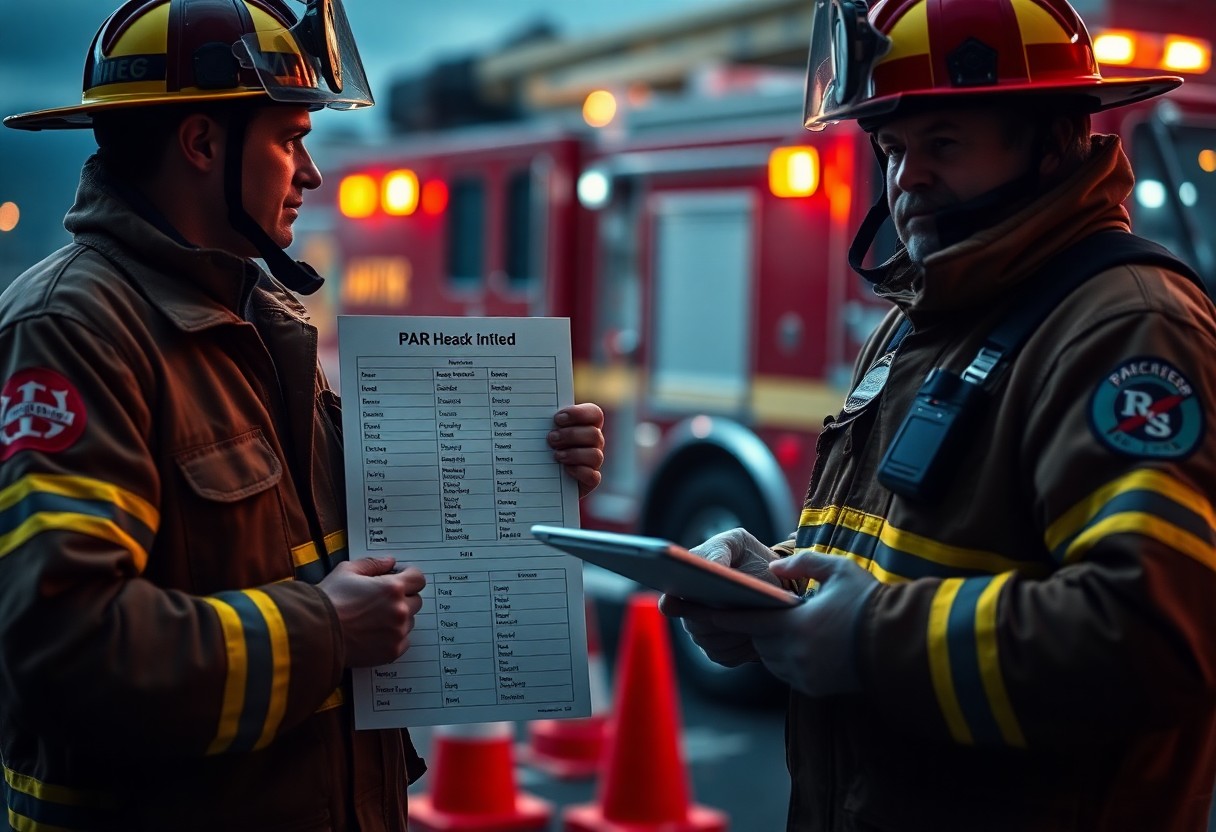
Use tactical worksheets and simple digital trackers so you can record locations, assignments, and statuses in real time; standardized fields cut radio time and make post-incident auditing faster.
Improving Response Times Without Sacrificing Accuracy
Practice short, focused PAR scripts and staging procedures so you can report and confirm teams quickly without losing accuracy during chaotic operations.
Optimize arrival performance by preassigning roles, mapping fastest access routes, and staging resources near likely entry points so you can deploy crews immediately; enforce radio discipline, use clear time benchmarks, and review delays after each incident to shave seconds without compromising methodical PAR confirmations.
Assessment and Continuous Improvement Strategies
Assessment anchors your continuous improvement: define measurable PAR metrics, collect incident and drill data, review compliance trends, and schedule regular audits so you can prioritize training needs and measure progress.
Utilizing After-Action Reviews to Identify Training Gaps
After-action reviews help you pinpoint training gaps by comparing expected PAR procedures to actual responses, documenting deviations, and assigning targeted corrective training so your crew improves response accuracy.
Refining Protocols Based on Departmental Performance
Adjust protocols when performance data shows weaknesses, updating PAR checklists, roles, and timelines so your team follows clearer, measurable steps during accountability checks.
When performance reviews reveal consistent delays, you should map specific failure points-crew handoffs, radio procedures, or role clarity-and rewrite protocol steps to remove ambiguity. Implement short, focused drills to validate changes, collect timing and compliance data, and adjust until metrics meet targets. Keep versioned SOPs, train supervisors on enforcement, and schedule quarterly performance audits so your department sustains improved PAR reliability.
Summing up
On the whole, you should practice PAR checks regularly, train clear roles and communication protocols, drill realistic scenarios, and review outcomes so you can maintain rapid, accurate accountability during incidents.
FAQ
Q: What is a PAR check and why should volunteer departments train for it?
A: PAR stands for Personnel Accountability Report and is the systematic process of accounting for every firefighter operating at an incident. The purpose of a PAR is to confirm location and status, reduce the chance of unaccounted personnel, and speed rescue if someone becomes lost, trapped, or injured. Volunteer departments benefit from PAR training because staffing levels, staffing changes during responses, and reliance on mutual aid increase the potential for miscommunication. Training should focus on simple, repeatable methods-clear assignment tracking, use of accountability tags or boards, consistent radio procedures, and set PAR checkpoints during incident phases.
Q: How do you structure practical PAR check training for volunteers?
A: Start with concise classroom instruction that defines roles (accountability officer, company officer, crew members), radio phrasing for PARs, and department policy on timing and triggers for accountability checks. Move to hands-on drills that use the actual tools volunteers will carry: accountability tags, clipboards, whiteboards, or electronic apps. Design scenarios that require crew rotations, rapid reassignment, and simulated MAYDAYs so trainees practice performing timed PARs under stress and in PPE. Assess performance with measurable criteria: completeness of roll call, time to complete a PAR, adherence to radio procedures, and accuracy of location reporting. Finish each session with an after-action review that lists specific corrective actions and assigns follow-up training.
Q: What practices keep PAR proficiency high over time in a volunteer force?
A: Integrate short PAR drills into routine meetings and apparatus checks so the skill stays fresh without large time investments. Schedule quarterly multi-company or full-scale exercises that test accountability across task assignments and mutual-aid partners. Maintain training logs that record drill results, common errors, and individual performance trends; use those logs to assign targeted coaching. Update checklists, accountability equipment, and radio templates based on lessons learned from exercises and incidents. Promote leadership modeling on-scene by having officers perform and require PARs during all significant operations, and recognize crews that consistently demonstrate correct accountability behavior.