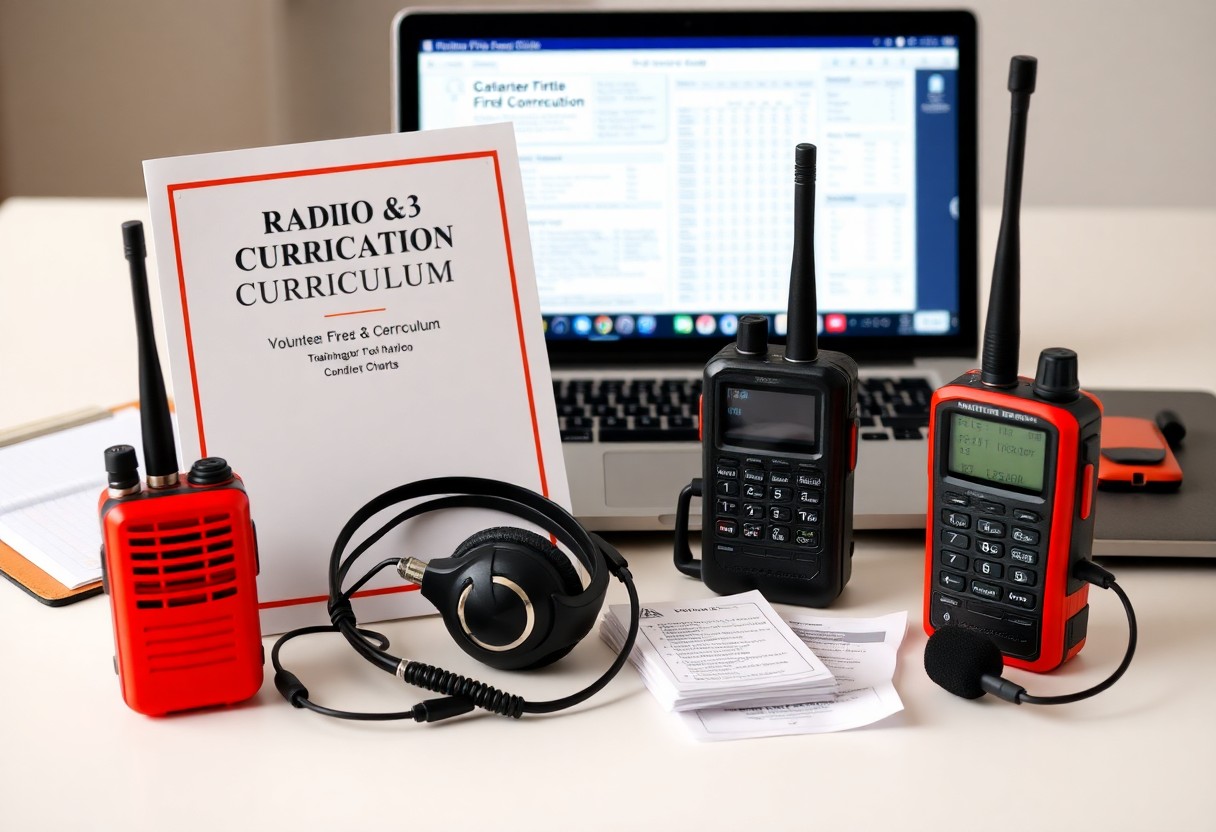
You will learn how to structure a practical radio communication curriculum that matches your department’s operational needs, covering foundational theory, hands-on radio procedures, standardized terminology, progressive skill assessments, scenario-based drills, and equipment maintenance; this guide shows you how to set learning objectives, create measurable competencies, schedule trainings, document certifications, and adapt content for volunteer schedules so your team gains reliable, repeatable radio skills for safer, coordinated responses.
Key Takeaways:
- Base the curriculum on local SOPs and ICS roles, using mission-specific scenarios to make training directly applicable to operational needs.
- Combine classroom instruction on radio protocols and channel management with hands-on exercises, role-played incidents, and routine radio checks.
- Structure training as competency-based modules with clear objectives, practical assessments, scheduled refreshers, and equipment maintenance checks to sustain proficiency and interoperability.
Assessing Needs & Setting Objectives
You should start by auditing 12 months of dispatch logs, incident reports and turnout times to quantify what communications actually matter: high-volume EMS calls, multi-unit structure fires, and mutual-aid events. Set objectives tied to measurable improvements-reduce misdirected transmissions by 50% and lower average on-air time per incident by 20% within six months. Use stakeholder interviews with chiefs, dispatchers and 10-20 frontline volunteers to validate requirements.
How-to identify operational communication requirements and risks
Audit radio traffic during peak shifts, map coverage gaps with drive-tests, and log instances of interference or failed transmissions. Count transmissions per incident-many departments log 25-75 radio calls on a single structure fire-and identify handoff points with EMS and mutual aid. You should flag terrain, high-rise antenna shadowing, noisy scenes, and volunteer turnover as risk drivers, then quantify their frequency to prioritize mitigations like repeaters or simplex fallback plans.
Tips for prioritizing learning objectives and measurable outcomes
Use the ABCD method: Audience, Behavior, Condition, Degree. Define objectives such as “you will perform 10 standard radio phrases with 90% accuracy under noise” or “liaison will reduce clarification callbacks by 50% within 3 months.” Link each objective to an operational metric-response time, transmission errors, or inter-agency handoff counts-so training targets are directly traceable to performance improvements.
- Rank objectives by incident frequency and severity: tackle objectives tied to the top 20% of incident types that generate 80% of transmissions.
- Assign timeframe and resources: aim for initial competency within 8 weeks with 4-6 practical drills and one full-scale exercise.
- Perceiving gaps through quarterly AARs, ride-alongs and proficiency logs lets you reweight objectives and close persistent weaknesses.
Break objectives into modules: basic phraseology (2 hours classroom, 1-hour practical), advanced incident coordination (3 hours simulation), and inter-agency interoperability drills (half-day exercise). Use rubrics with observable behaviors-call sign protocol, brevity, confirmation-graded pass/fail where passing is 90% accuracy. Schedule refresher micro-sessions every 6 months and measure progress with blind proficiency checks and post-incident audits to validate learning transfer.
- Set measurable targets: 90% correct phraseology, <5% transmission errors, and reduce clarification callbacks by 50% in six months.
- Use mixed assessments: written quizzes, timed on-air drills, and recorded scenario evaluations scored by trainers.
- Perceiving outcome trends from dashboards and after-action metrics will guide when to re-run modules or escalate to mandatory retraining.
Designing a Modular Curriculum
How-to structure modules for progressive skill development
Map modules into four progressive tiers: Foundations (radio parts, basic procedures), Operational (net control, phraseology), Interoperability (multi-agency talkgroups, mutual aid), and Advanced (incident comms leadership, encryption/patching). You should design 6-8 focused modules per tier, each 45-90 minutes or as half-day workshops for hands-on labs. Assess competence with short practical checks after each module, require prerequisites for advanced topics, and use blended delivery-micro e-learning plus in-person skill stations-to speed mastery.
Tips for integrating hands-on practice and scenario-based drills
Integrate short, frequent drills: run a 15-30 minute radio-check each shift and schedule one full-scenario drill monthly (60-90 minutes) that includes multi-agency voice traffic, simulcast patches, and channel switching. You should rotate net controllers every 10-15 minutes and use recorded playback for debriefs. Include measurable objectives-message clarity, time-to-acknowledge target of <30 seconds, and zero unauthorized transmissions-to track improvement.
- Use handhelds and base stations in drills to emulate noise, terrain and range limits.
- Record at least one drill per quarter and tag recurring errors for targeted retraining.
- Thou must document action items, responsible persons, and completion dates in the after-action log.
Design scenarios that add complexity in stages: start with a single-vehicle incident, progress to a multi-unit fire with a hazmat and concurrent medical call, then include EMS and law enforcement talkgroups. You should script realistic background noise, inject a radio-failure event for redundancy practice, and require use of ICS talkgroups. Measure performance with five metrics-message accuracy, brevity, correct prowords, switch time, and debrief action-closure rate-and assign mentors to coach during playback.
- Scripting: include injects at 5, 15, and 30 minutes to test adaptability.
- Assessment: use checklists and scorecards; aim for >85% proficiency post-training.
- Thou should maintain a training log with dates, attendees, and remediation steps for accreditation.
Core Technical Topics & Standards
You focus on NFPA 1221, NIMS/ICS radio planning (ICS-205), and FCC licensing while teaching specifics like VHF 150-174 MHz vs UHF 450-470 MHz behavior, P25 Phase 1/2 differences, and 12.5 kHz narrowbanding. Include measurable maintenance cycles-monthly radio checks and annual bench tests-plus talkgroup naming conventions, encryption policy, and documented SOPs so crews execute consistent communications during multi-agency events.
How-to teach radio fundamentals, protocols, and SOPs
You combine short classroom briefs (20-40 minutes) on phonetics, plain language, and PTT technique with hands-on drills for battery/antenna checks and basic troubleshooting. Run role-play incidents using an ICS-205 radio plan, then grade performance with a checklist. Use simulators or live cross-band exercises so trainees practice interoperability under stress and you can quantify competency.
Factors to include: interoperability, frequencies, and safety procedures
Your syllabus must cover mutual-aid talkgroups, frequency coordination, encryption rules, and RF-safety limits. Teach channel spacing (12.5 kHz), talkgroup load management, and FCC license responsibilities. Include minimum separation for high-power antennas, PPE for RF exposure when required, and clear handoff procedures as units move between jurisdictions.
- You define shared talkgroups and naming conventions so agencies can patch within minutes during surge responses.
- You document band assignments (VHF 150-174 MHz, UHF 450-470 MHz), narrowbanding status, and encryption policy per channel.
- The training must include inventory audits, monthly radio checks, and annual FCC/bench test verifications.
You should map channels by function-tactical, command, logistics, medical-and keep one primary tactical talkgroup per division to limit congestion. Conduct quarterly multi-agency interoperability exercises, maintain programming templates, and keep a spare-radio cache equal to at least 10% of active units. Track serial numbers, firmware versions, and battery cycles in a central log so you can audit readiness before major incidents.
- You schedule quarterly joint comms exercises and capture lessons learned in an AAR.
- You maintain programming templates, firmware logs, and a spare cache equal to 10% of deployed radios.
- The after-action reports should drive SOP updates and training rosters.

Training Methods & Assessment
You should balance theory, hands-on practice, and full-scale exercises: aim roughly for a 30/50/20 split (classroom/drills/simulations), deliver 1-2 hour classroom modules, run monthly drills and two simulations per year, and use after-action reviews to close gaps; this blended approach supports skill acquisition and operational integration for volunteer crews with varied availability.
How-to choose delivery methods: classroom, drills, simulations
You choose classroom when you need standardized knowledge delivery-keep sessions to 60-90 minutes with clear learning objectives; schedule 2-4 practical drills per month focused on 6-12 core radio tasks; run integrated simulations 1-2 times annually to test interoperability with dispatch and mutual aid. Station 7 found quarterly simulations exposed ICS handoff issues that drills didn’t reveal.
- Classroom: 60-90 minute modules, slide + hands-on demo.
- Drills: 2-4 monthly sessions, 6-12 repeatable tasks (call sign, channel change, emergency traffic).
- Simulations: 1-2/year, multi-team scenarios with dispatch and AAR.
Recognizing your station size and call volume will determine whether you front-load drills or increase simulation frequency.
Tips for competency assessments, retention checks, and certification
You should use objective tools: a 12-item skills checklist for practical exams, an oral scenario evaluation, and a 30-minute online retention module every quarter; set a certification pass threshold (e.g., 85%) with recertification annually and targeted remediation for failures-document scores in an LMS to track trends across volunteers and stations.
- Skills checklist: 12 core radio tasks, pass threshold 85% for certification.
- Assessment types: practical observed, oral scenario, and written/online refreshers.
- Timing: quarterly 30-minute retention checks, annual recertification, remedial training as needed.
Recognizing that variables like turnover and call frequency affect decay, schedule higher-frequency retention checks for high-turnover teams.
You should standardize rubrics and train assessors: use inter-rater calibration sessions to keep evaluations consistent, record assessments in a central log, and require corrective action plans for anyone below threshold; issue time-limited certificates (12 months) linked to LMS completion reports to automate reminders and supervisor oversight.
- Inter-rater calibration: quarterly assessor meetings to align scoring.
- Documentation: centralized LMS with timestamped assessments and remediation plans.
- Certification: 12-month validity, automated renewal reminders, supervisor sign-off.
Recognizing leadership engagement-publish completion dashboards and assign accountability to captains to sustain program compliance.
Instructor & Resource Planning
How-to select and prepare qualified instructors and mentors
You should pick instructors with 3+ years of front‑line radio use and documented teaching experience; prioritize Fire Instructor I/II or equivalent and NIMS ICS courses (100/700). Require a 16‑hour train‑the‑trainer workshop, observed classroom and practical assessments, and a minimum of 20 hours co‑teaching with a senior mentor before independent delivery. Keep qualification records and refresher training every 12 months.
Factors for budgeting, equipment procurement, and maintenance
Budget line items should include portable radios ($350-900 each), mobile units ($700-1,500), repeaters ($5,000-20,000), batteries and chargers, and spare parts; plan replacement cycles of 5-7 years and annual maintenance at 5-10% of equipment value. Apply for AFG/state interoperability grants, negotiate 10-20% bulk discounts, and set a spare inventory equal to 10-20% of active radios.
- Prioritize compatibility with regional talkgroups and encryption requirements when procuring.
- Include firmware updates and programming in vendor contracts to avoid unexpected costs.
- Factor in battery replacements every 1-3 years and accessory replacement rates.
- Assume that you will maintain at least one spare handheld per ten active users and a maintenance contract covering firmware and bench testing.
Track assets with barcode or RFID tags, log weekly radio checks and monthly battery capacity tests, and schedule annual bench calibration; store master codeplug files and programming backups offsite. Train at least two personnel in radio programming and vendor liaison, and keep a 20% spare pool to cover surge staffing during multi‑unit responses.
- Use a simple CMMS or spreadsheet with asset ID, purchase date, warranty, and next service date.
- Require defect reports be entered within 48 hours and repairs logged with parts used and technician name.
- Keep a vendor contact list with SLA terms and a dedicated line for emergency repairs.
- Assume that you will retain encrypted offsite backups of all codeplugs, programming files, and maintenance records to support rapid replacement and audit compliance.
Continuous Improvement & Compliance
You run quarterly curriculum reviews, conduct after-action reviews (AARs) after incidents, and schedule annual compliance audits against NFPA 1221 and local FCC rules. Track KPIs such as drill pass rate, average radio response time, and message accuracy using an LMS or simple spreadsheet dashboards. Assign corrective actions with owners and 30-day deadlines to close gaps identified in AARs and audits.
How-to collect feedback, measure performance, and revise curriculum
You combine short post-training surveys, ride-along observations, and recorded drill analysis to collect both qualitative and quantitative data. Score simulations with a 0-100 rubric targeting an 80% proficiency threshold, audit 50 recorded transmissions per quarter, and convert AAR findings into 1-3 clear syllabus changes with owners and timelines for revision.
- Use 5-question Likert surveys immediately after sessions to capture clarity and confidence in under 2 minutes.
- Analyze 50 radio calls per quarter for phraseology, brevity, and protocol adherence; log error types and frequencies.
- Assume that you will resize lessons by 10-20% or add micro-modules when average scores fall below 80%.
Tips for keeping content current with technology and regulatory changes
You monitor FCC rulemakings, APCO technical advisories, and manufacturer firmware notes monthly, update training materials within 90 days of substantive changes, and maintain a tested spare fleet to validate new software before field deployment. Partner with your comms engineer and document a formal change-log tied to curriculum versioning and instructor briefings.
You assign a single owner to triage tech and regulatory alerts, subscribe to FCC daily digests and vendor release lists, and run bench validations on at least 5 radios per firmware update. Create 10-15 minute microlearning updates for rapid dissemination and schedule a 30-day follow-up drill to validate retention and operational impact.
- Subscribe to FCC weekly notices, APCO bulletins, and vendor firmware feeds to get timely alerts.
- Bench-test updates on 5 radios, run a 7-day operational pilot, and record performance metrics before full rollout.
- Assume that you will halt live deployments until bench-tested changes pass a 7-day trial and a documented go/no-go decision is signed.
Summing up
As a reminder you should begin by assessing your team’s missions and radio capabilities, then set clear, measurable learning objectives aligned with incident protocols. Build a curriculum combining classroom theory, hands-on radio drills, interoperability exercises, and SOP literacy. Include instructor guides, assessment rubrics, and scheduled refresher training, and ensure equipment familiarity and documentation. Track performance with evaluations and update content after exercises or technology changes so your team stays operationally ready.