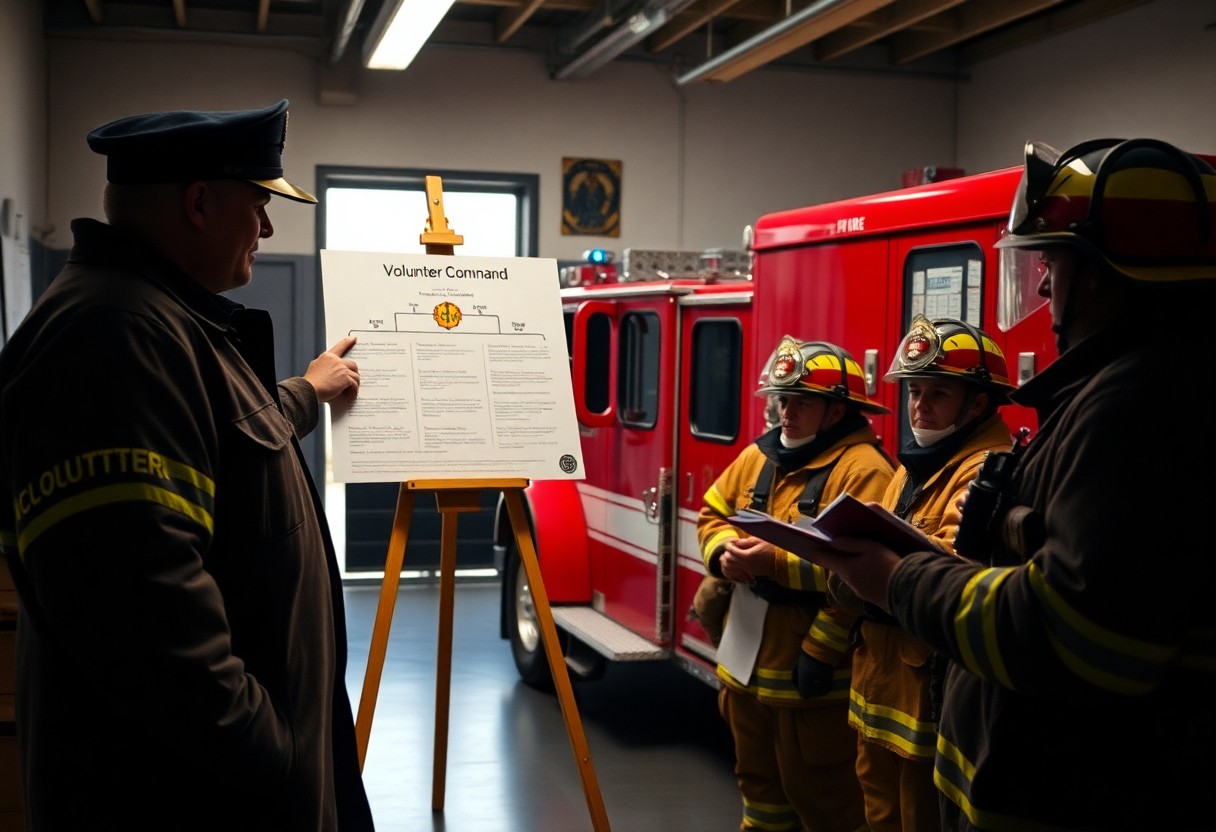
Most volunteer fire departments rely on a clear chain of command, and you can strengthen your chain by defining roles, standardizing procedures, conducting regular training, and enforcing accountability; communicate expectations clearly, practice decision-making under pressure, and build trust so every member knows when to lead and when to follow.
Understanding the Chain of Command
Definition and Importance
You rely on the chain of command to convert strategy into action during routine calls and major incidents, assigning clear authority for decisions and accountability for outcomes. NIMS recommends a span of control of 3-7, with about 5 direct reports as an operational target. When you enforce that structure, you cut radio traffic, speed tasking, and reduce conflicting orders-especially important when mutual aid brings unfamiliar crews to your scene.
Key Roles in the Structure
You should define specific roles: Fire Chief (overall policy and external liaison), Deputy/Assistant Chief (operations/admin), Battalion or Shift Commander (incident command), Captain (company officer for apparatus), Lieutenant (crew leader), plus EMS, Training, and Safety Officers for specialties. Assign one company officer per apparatus and maintain the 3-7 span of control to keep supervision effective during responses and drills.
Operationally, clarify responsibilities and transfer points: set written thresholds for when command elevates (for example, when more than 15 personnel are working, multiple companies are operating, or a new operational division is needed). You can implement a platoon system-three 20-person shifts in a 60-member department with one deputy overseeing-and use job descriptions that list decision authority, reporting lines, and examples of delegated tasks so officers act confidently and consistently under stress.
Identifying Factors for Strengthening Command
Pinpoint gaps in span of control, training, and SOP adherence by auditing recent incidents and shift drills; NFPA 1561 and ICS guidance give measurable benchmarks for role assignment and accountability. Track metrics such as time-to-decision, radio clarity scores, and percentage of your personnel with ICS 100/200 completed; set targets (e.g., 90% certification within 12 months). Thou must document findings in a simple action plan that assigns owners, deadlines, and verification steps.
- Span of control – maintain roughly 3-7 personnel per supervisor depending on complexity
- Training completion – ICS 100/200, officer development, and scenario-based drills
- SOP clarity and accessibility – searchable, version-controlled documents
- Communications – designated talkgroups, repeat-backs, and monthly radio checks
- Leadership continuity – deputy roles, mentorship, and succession plans
- Staffing & equipment – minimum daily staffing levels and standardized apparatus setups
Leadership Qualities
You should prioritize decisiveness, situational awareness, and consistent delegation; run monthly scenario-based drills and pair new officers with seasoned mentors for 1:1 coaching. Use structured six-month performance reviews and require leaders to log incident decisions so you can audit judgment under stress. Rotate command roles during training to expose deputies to at least a dozen incident types over a year, accelerating experience without risking operations.
Communication Strategies
Standardize briefings by requiring a 60-second size-up and clear assignments, enforce closed-loop communication and repeat-backs, and use phonetic clarifiers on radios; NFPA 1221 guides equipment and comms planning. Run monthly radio checks, log dead-air instances, and train crews on interference scenarios so your teams maintain clarity during high-noise incidents.
Assign a communications officer for incidents exceeding two engines or when mutual aid arrives, pre-designate talkgroups for command, interior, and logistics, and require each apparatus to carry one spare radio battery and a portable repeater plan. Conduct after-action reviews focused on radio failures, tally repeat-back errors, and set measurable targets (for example, cut errors by half within six months) so your department can track and verify improvement.
How-To Implement Training Programs
You should build an annual training calendar that blends classroom, hands-on and scenario work: schedule four quarterly drills, two 8‑hour leadership workshops, and monthly 60-90 minute station exercises. Use NFPA 1001/1021 and NIMS/ICS benchmarks, track competencies in a skills matrix of 12 core tasks, and measure improvement with pre/post tests and time-to-command metrics to show progress.
Developing Leadership Skills
You should pair aspiring officers with veteran mentors for 6‑month rotations, mandate an 8‑hour decision‑making course tied to NFPA 1021, and require completion of three leadership simulations before promotion. Incorporate 360° feedback, set SMART goals, and use monthly check-ins so you can track milestones and strengthen command continuity.
Conducting Team-Building Exercises
Rotate command roles during 60-90 minute monthly scenario drills-assign a duty officer, safety officer, and two truck/company leads-so you practice decision flow and communication under stress. Use progressive complexity: tabletop, live role-play, then full apparatus drill; capture radio logs and compare errors per drill to reduce miscommunication.
Start with 30‑minute tabletop sessions that map roles and radio procedures, then advance to 60-90 minute hands-on scenarios like a 3‑vehicle MVA or structure fire with controlled props. Run a full-scale multi‑agency drill quarterly, record time-to-command and number of command transfers, and conduct a 5‑minute hot wash plus written AAR within 72 hours so you can prioritize fixes.
How-To Foster Open Communication
Encouraging Feedback Loops
Use a mix of anonymous monthly surveys (5‑point scale) and quick post-incident debriefs to surface issues you wouldn’t hear in formal settings. Ask three focused questions-what went well, what impeded you, what needs change-and track responses in a shared log. Aim to close 80% of actionable items within 30 days and publish status updates so volunteers see their input driving change.
Establishing Regular Meetings
Schedule brief, predictable touchpoints: 15-20 minute weekly station briefs, a 60-minute monthly leadership meeting, and a quarterly all-hands review. Use set agendas, time limits, and assigned facilitators so meetings stay efficient; require a one-page pre-brief for topics needing decisions. Track attendance and outcomes in your meeting minutes repository.
For implementation, create a standard agenda template: 1) safety check (5 min), 2) operational updates (5-10 min), 3) training and equipment needs (5-10 min), 4) open items and action assignments (5 min). Rotate facilitation monthly to develop leaders and prevent bottlenecks. Use a simple digital tool-Google Drive or a shared spreadsheet-to list action owners, deadlines, and status; in a 30-person volunteer department this approach reduced duplicated tasks and improved response coordination within two quarters. Enforce a follow-up routine: assign owners during the meeting, send minutes within 24 hours, and review outstanding actions at the next session.
Tips for Conflict Resolution
When tensions rise on shift, you should apply clear escalation steps, time-bound interventions, and consistent documentation to keep the chain of command intact; use a 3-step escalation (peer discussion, officer mediation, chief review) and aim to resolve minor disputes within 72 hours. After that, you should document outcomes and track trends quarterly.
- Define 3 escalation levels you follow with response times: 24 hours, 72 hours, 7 days.
- Require you to create written incident notes for repeat issues (2+ in 6 months) to trigger review.
- Use your anonymous monthly surveys and post-incident debriefs to spot patterns quickly.
- Train at least two peer mediators per station so you have neutral first responders.
Recognizing and Addressing Issues
You pick up early warning signs like repeated absenteeism, SOP deviations, or 2+ complaints in six months; document specifics, interview involved parties within 48 hours, and map incidents to patterns by shift, apparatus, or training gaps. Use corrective coaching for first offenses, formal counseling on second, and escalate persistent problems to the officer-in-charge with a recommended action plan.
Implementing Mediation Techniques
You structure mediation as a 30-60 minute session with a neutral facilitator, three ground rules (equal talking time, no interruptions, focus on actions), and a written agreement signed by participants; schedule a 7-day follow-up to assess compliance and morale improvement. Use role-play and a timed speaking token to enforce fairness during the session.
You assign one trained facilitator per three stations or hire an external mediator when neutrality is in doubt; train mediators with a 6-hour workshop covering active listening, reframing, and agreement drafting. Track outcomes: aim for 80% resolution within 30 days, log compliance at 7 and 30 days, and review aggregated data quarterly-Station 8 reported a 60% drop in repeat complaints after a year using this protocol.
Continuous Improvement Strategies
Evaluating Performance
Track concrete metrics-turnout time, dispatch-to-arrival, equipment-check completion rates-and run monthly after-action reviews (AARs) to analyze deviations. You should use quarterly skills assessments and ride-alongs to validate competence; for example, Station 8 cut average turnout from 120 to 70 seconds after targeted drills. Combine quantitative KPIs with qualitative feedback from crews to pinpoint training gaps and update SOPs within 30 days of recurring findings.
Adapting to Change
Embrace incremental pilots when introducing new protocols or technology so you can measure impact before full rollout; a six-week tablet checklist pilot reduced report time by 40% at one volunteer unit. You must assign a change lead, set baseline KPIs, and require weekly progress updates to maintain momentum and accountability.
Operationalize change by forming a three-person implementation team, running a 6-8 week pilot, and defining success criteria-target 85% crew competency within 90 days. Train in short, focused sessions (two 30-minute briefs per week), collect AAR data, and iterate: if a metric worsens by more than 10%, revert or adjust the protocol and re-test to keep the chain of command effective during transitions.
Conclusion
From above, you can strengthen your department’s chain of command by defining roles and responsibilities, enforcing clear lines of authority, conducting regular joint training and incident drills, establishing succession plans, and maintaining disciplined, transparent communication and accountability; these measures help you build operational consistency, rapid decision-making, and resilient leadership in every response.