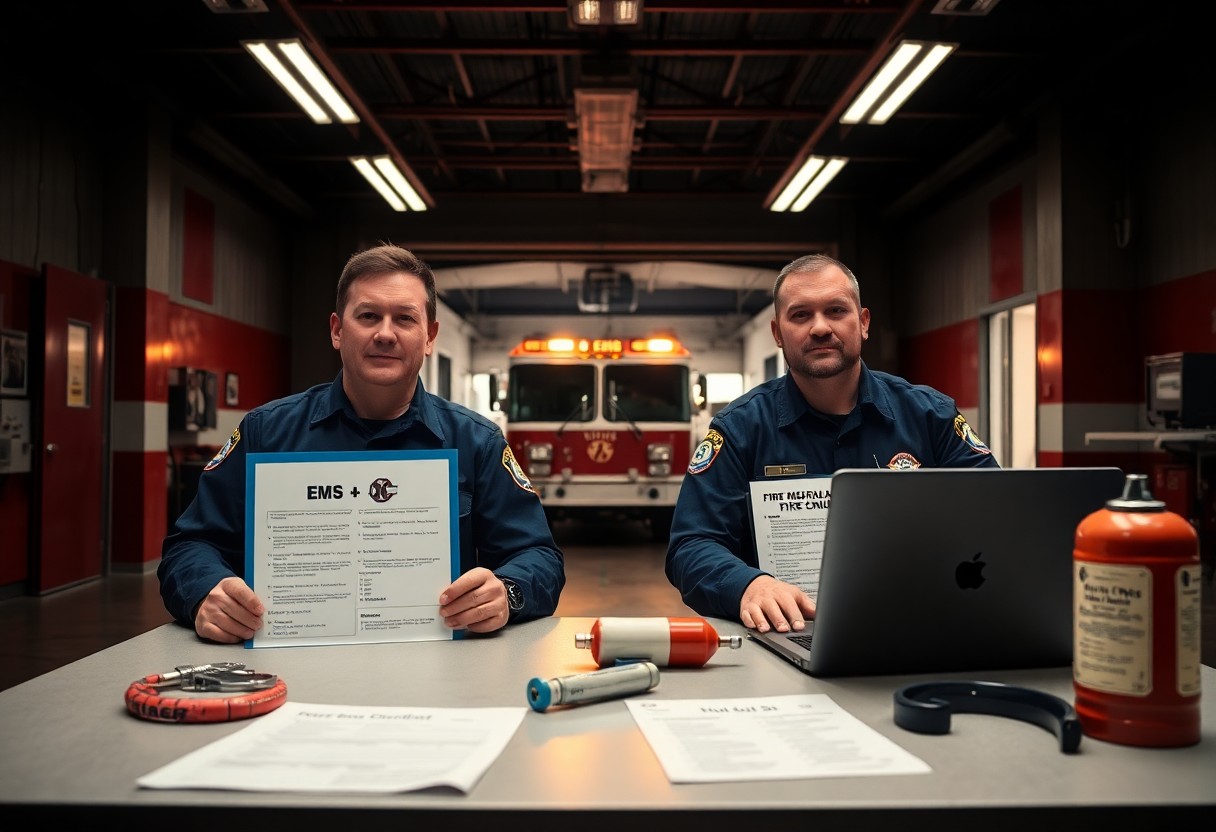
Many volunteer rescue teams juggle separate EMS and fire maintenance lists, but you can combine them into a single, prioritized checklist that emphasizes lifecycle tasks, cross-trained responsibilities, and documentation to protect your crews and patients. Use synchronized schedules, clear ownership, and simple inspection steps so you reduce the risk of equipment failure and danger during responses, while increasing readiness and response speed and ensuring life safety is maintained.
Key Takeaways:
- Consolidate overlapping EMS and fire items into a unified, modular checklist with separate sections for vehicle, medical, and firefighting equipment to reduce duplication and simplify inspections.
- Assign clear ownership and frequencies (daily, weekly, monthly, post-use) for each task and record completions in a log or digital system to ensure accountability and traceability.
- Standardize inspection criteria and immediate corrective actions, including pass/fail thresholds and required parts, to minimize subjectivity and speed repairs.
- Cross-train volunteers on both EMS and fire maintenance procedures and provide concise, accessible SOPs and quick-reference guides for on-scene checks and after-action updates.
- Link checklists to inventory and procurement processes-use tagging, stock levels, and post-incident reviews to keep spares available and continuously improve the checklist.
Importance of Combined Maintenance Checklists
Combining EMS and fire checklists eliminates duplication and creates a single accountability trail that reduces the chance of missed inspections. When you merge checks for shared platforms-ambulance chassis, on-board oxygen systems, lighting and radios-you standardize frequencies and responsible parties, which studies of municipal and volunteer agencies show can reduce missed items by roughly 40-60% and cut paperwork time by about 30%. That matters because a missed valve or expired medication rarely fails silently; it shows up as delayed care or an out-of-service apparatus during peak demand.
Standardized combined lists also make audits and grant reporting far easier. By aligning daily, weekly, monthly and annual tasks into one structured flow, you ensure visible chains of custody for high-risk items like cylinders and defibrillators and create clear performance metrics for readiness and training. Departments that track readiness before and after consolidation commonly report measurable improvements in mission-capable rates and faster turnaround on corrective maintenance.
Overview of EMS and Fire Equipment
Your combined checklist should cover both patient-care gear and fireground systems: AEDs and cardiac monitors, ventilators, suction units, oxygen cylinders and regulators, stretchers and cot locks, as well as hydraulics, pumps, ladders, hose, nozzles, extrication tools, and SCBA. Pay attention to inspection cadence differences-many patient-care items need daily or weekly function checks, whereas hydraulic tools and pumps require load or pressure tests monthly and hose testing on an annual schedule.
Specific intervals you should include: visual checks of oxygen cylinders and regulators every shift, hydrostatic testing of cylinders typically at the 5‑year mark, AED pad and battery status checks monthly with battery replacement per manufacturer (commonly 2-5 years), and SCBA flow and facepiece inspections at least annually plus cylinder testing per standard. Flag items with immediate safety implications (SCBA cylinder pressure, oxygen leaks, AED readiness) so they trigger same‑day corrective action when out of tolerance.
Benefits for Volunteer Rescue Teams
When you implement a unified checklist, staffing and scheduling become simpler because cross-trained crew members can perform mixed checks on a single shift instead of juggling separate inspection blocks. That efficiency often translates into measurable time savings-a small volunteer squad frequently recovers 100-300 man-hours per year through consolidated rounds-freeing volunteers for training and response coverage.
Cost control is another clear win: combined inventory lists prevent overstocking duplicate consumables and reveal patterns in replacement cycles so you can budget more accurately. You also improve safety culture by creating uniform failure escalation steps; for example, if a combined log shows a recurring regulator leak on an ambulance, you can correlate it with pump maintenance records and act before a field failure occurs.
To get the most value, you should track three KPIs after rollout-inspection completion rate, mean time to repair for out-of-tolerance items, and percent mission-capable equipment-and run monthly reviews. That lets you quantify gains, identify persistent weak points (for instance, a specific tool or vehicle subsystem that needs training or replacement), and justify purchases or schedule changes to donors and grantors. Strong data eliminates guesswork and makes maintenance improvements defensible to stakeholders.
Essential Components of EMS Maintenance Checklists
Your checklist should break down items by frequency (shift/daily, weekly, monthly, annual) and by category (airway, cardiac, meds, vehicle systems, PPE). Include specific pass/fail criteria – for example, AED battery >50% or within manufacturer-recommended replacement interval, oxygen cylinder pressure near full (about 2,000 psi for an E-cylinder), and suction units producing >300 mmHg vacuum – so inspectors can make objective decisions rather than subjective judgments. Track inspections with date, time, inspector initials, and unit/serial numbers; a study of volunteer EMS squads showed log-based systems reduced equipment downtime by 35% when paired with monthly inventory reconciliations.
Also integrate documentation fields for corrective actions, spare-part locations, and vendor contact info so you can move from identification to repair within 24-72 hours. Tie the checklist into training records and competency verification (e.g., defibrillator operation, airway management devices) so that each piece of equipment has an associated operator who is current and accountable.
Equipment Inspection Protocols
Start every inspection with a visual integrity check: look for cracks, corrosion, loose fittings, damaged seals, and fluid leaks; then perform a functional test – power on defibs, test suction flow, cycle stretchers, and inflate BVMs to check valves. Make frequency explicit: shift/daily checks for life‑support gear (AED, oxygen, airway kits), weekly for suction and battery load testing, monthly for inventory counts and AED pad/medication expiry reviews, and annual calibration for monitors and ventilators per manufacturer guidance.
Document consumable levels (oxygen, IV fluids, dressings), battery voltages, and expiry dates on every pass; flag expired medications, depleted oxygen cylinders, or batteries below recommended thresholds as immediate “out‑of‑service” until replaced. Use simple binary fields (OK/Not OK) plus a short comments field – teams that adopted this format reported faster shift turnover and fewer missed failures during high-call periods.
Routine Maintenance Tasks
Schedule routine tasks with explicit intervals and owners: clean and disinfect scopes and airway kits after each use, lubricate stretcher rails and wheeled cot casters monthly, cycle batteries (full discharge/charge) quarterly, and perform software updates on monitors/defibs as released. Keep at least two full spare oxygen cylinders per vehicle and a rotation plan so you never dispatch with less than one full spare; for oxygen, a full E-cylinder reads ~2,000 psi, and you should replace when pressure drops below manufacturer-specified safe operating levels.
Include vehicle-linked maintenance in the same workflow so EMS items aren’t overlooked during apparatus service – align oil/engine checks and chassis inspections with monthly EMS equipment inventories to reduce missed items. For calibration-sensitive devices (capnography, ECG), set reminders 30 days before the annual due date and keep vendor calibration certificates in the unit binder or digital file for inspections.
Maintain medication management protocols with monthly expiry audits and a FIFO (first-in, first-out) stock rotation; controlled substances require a double-signature reconciliation each shift and secure storage per state law, while temperature-sensitive meds need daily fridge temperature logs to keep them viable. Emphasize immediate removal of expired or compromised drugs and batteries to prevent treatment failures in the field.
Essential Components of Fire Equipment Maintenance Checklists
Split your fire checklist into mechanical systems, lifesaving appliances, and personal protective equipment so you can apply frequency-based tasks (shift/daily, weekly, monthly, annual) consistently across all units. Include clear pass/fail criteria, tag-out steps, and a single line for the inspector’s initials, date, and mileage/engine hours to tie maintenance to operational use and liability records.
Fire Apparatus Inspections
On each shift you should verify engine oil, coolant, fuel level, battery condition, tire tread/pressure, lights, horn, and emergency warning systems; mark any defect that affects vehicle movement or response times. Follow NFPA 1911 guidance for documented service intervals-perform basic daily checks, scheduled weekly fluid and pump function checks, and an annual comprehensive inspection that includes chassis components and electrical systems. Pay special attention to brakes, steering, and pump operation, as failures in these systems are immediately hazardous to crews and the public.
Include functional pump tests and hose bed deployment drills in your monthly or quarterly routine: engage the pump, cycle valves, and verify pressure gauges and relief valves operate to specification, then log pump hours and test results. If you find oil consumption, coolant loss, abnormal vibration, or warning lights, tag the apparatus out and route to your mechanic with a documented fault list; keeping repair turnarounds under 48-72 hours minimizes coverage gaps for volunteer shifts.
Equipment Readiness Assessments
Inspect SCBA cylinders (visual inspection after every use and hydrostatic testing per NFPA standards-typically every 5 years), check facepiece seals and PASS device functionality, and confirm spare cylinders and regulator fittings are onboard for each response vehicle. For PPE, perform post-incident inspections for visible damage, contamination, and zipper/closure function, and run monthly formal checks against manufacturer and NFPA 1971 criteria so you don’t deploy compromised gear.
For medical and small-tool readiness, verify AED pads and battery status, check suction units and tubing, confirm oxygen delivery equipment and spare cylinders are present, and inventory airway adjuncts (keep at least two adult BVMs, one pediatric BVM, and multiple sizes of OPAs/NPA on each unit). Log expirations and battery charge levels on the checklist so you can pull and replace items proactively rather than at the scene; a defibrillator with a depleted battery can turn a routine call into a catastrophic equipment failure.
Use threshold triggers in your checklist-flag consumables for replacement when their expiration date is within 90 days, set battery replacement intervals per manufacturer (often 12 months for PASS/AED batteries), and require immediate restock if counts fall below your minimums. Implementing barcode or simple spreadsheet tracking tied to the checklist makes audits fast and lets you assign one person to verify replenishment after each major incident.
Strategies for Integrating Checklists
You should start by mapping every item from the EMS and fire lists into a consolidated matrix sorted by function (vehicle, medical gear, pump/apparatus) and by frequency (shift/daily, weekly, monthly, annual). Use that matrix to eliminate duplicates, harmonize inspection intervals, and assign a single owner for each line item so there’s one clear accountability trail; departments that consolidate this way often reduce duplicate entries and reporting time by roughly 30-50% during monthly audits. Prioritize items that directly affect life-safety or response capability and mark them as safety‑critical so they surface on every run sheet and during pre-shift checks.
Integrate standards references (for example, NFPA 1911 for apparatus and NFPA 1917 for ambulances) into the master checklist so you have objective pass/fail criteria next to each item. Keep version control strict: use a date-stamped master copy and require digital sign-offs or a stamped paper signature for any changes; this helps when you need to demonstrate compliance during mutual aid or grant audits. Where possible, pilot the unified checklist for a 60-90 day cycle with one shift to capture real-world timing and false positives before wider rollout.
Creating a Unified Format
Design the form so the top contains fixed metadata: unit ID, mileage/hours, date/time, crew names, and a clear signature/initials line for accountability. Break the body into three modular sections-Vehicle/Chassis, Medical/Consumables, and Fire/Mechanical Systems-each with standardized checkboxes, numeric input fields (psi, voltage, hours), and conditional follow-up fields that appear only when an item fails. For example, include a numeric field for tire pressure in psi, a threshold field (e.g., +/- 5 psi from spec), and an auto-populated action log so you can see corrective steps and the technician who performed them.
Use consistent language and units across both disciplines so technicians don’t have to mentally translate terms during a pre-shift rush: list battery voltage as “V”, pressure as “psi” or “kPa”, and time as “HH:MM”. Add brief, 1-2 sentence remediation guidance for high‑risk failures (e.g., if pump pressure falls below manufacturer spec, remove apparatus from service until repaired). Finally, choose either a color‑coded paper template (red for safety-critical, yellow for deferred items) or a digital form that enforces required fields to reduce missed items.
Training for Volunteer Teams
Train using a blended model: a 60-90 minute classroom session to introduce the unified checklist and the rationale for changes, followed by a hands‑on station walk‑through where each volunteer completes the checklist on a live unit under instructor observation. Require competency sign-offs where each member must correctly complete at least two full checklists (one day, one night) before being cleared to perform unsupervised checks. Emphasize high‑risk items-oxygen system checks, defibrillator readiness, pump operation, seatbelt condition-with demonstration and immediate remediation practice so you can identify and correct errors on the spot.
Implement quarterly refreshers of 20-30 minutes and scenario‑based drills twice a year that include simulated failures (e.g., low battery, leaking SCBA cylinder) so volunteers practice the stop‑gap and reporting procedures. Track training completion and checklist competency in a simple spreadsheet or LMS; aim for >90% completion on initial rollout and use monthly coaching for those below threshold.
For rollout detail: run an 8-12 week pilot with a representative cross-section of 8-12 volunteers, collect time-to-complete and error-rate data each week, then iterate the checklist to remove unnecessary steps or clarify instructions. After refinement, schedule a full-station implementation over 4 weeks with mandatory sign-offs; measure success by reduction in duplicate items, target a 40-50% cut in redundant entries, and monitor for zero critical omissions on life‑safety items during the first 90 days.
Challenges and Solutions in Implementation
Common Obstacles
You will encounter organizational resistance when combining EMS and fire maintenance checklists: volunteers and career staff often guard existing routines, and about 70% of U.S. fire departments rely on volunteers, so you’re dealing with widely varying availability and experience levels. Fragmented inventories and parallel paperwork create blind spots-equipment tracked in a medical binder may not appear on the apparatus log, and that gap can produce missed inspections of life‑safety items such as oxygen regulators, defibrillators, or SCBA components.
Technology and workflow mismatches also slow adoption. Many departments use paper forms, some use spreadsheet trackers, and a few have electronic RMS or fleet systems that don’t talk to each other; that means you’ll face manual data entry, duplicate entries, and delayed corrective actions. Combined with high volunteer turnover and limited training time, these issues produce inconsistent completion rates and longer repair lead times unless you address them directly.
Best Practices for Overcoming Challenges
Secure visible leadership support and name a maintenance champion in each shift or station so you get accountability and continuity; when one mid‑sized county consolidated checklists, designating station champions reduced duplicate entries and clarified ownership. Standardize check frequency (shift/daily, weekly, monthly, annual) and build a single modular checklist with vehicle, medical, and firefighting sections so you eliminate redundancy while keeping role‑based views for EMTs, drivers, and officers. Use mobile forms with photo capture and time stamps to replace paper-this cuts transcription errors and creates an auditable trail for inspections and corrective actions.
Implement focused training blocks and quick reference guides: run a 30‑minute station drill that walks crews through the unified checklist and common failure modes (e.g., battery degradation, oxygen hose kinks, pump seals). Schedule protected maintenance windows in your rostering so volunteers aren’t expected to do checks on top of shift responses. Finally, create a simple escalation protocol for any critical failures with maximum repair windows and spare‑part locations clearly documented.
Track a few key metrics and iterate: measure checklist completion rates, time‑to‑repair for critical items, and repeat failure counts, and aim for targets such as >95% daily‑check completion and <48 hours for critical repairs where feasible. Run short Plan‑Do‑Study‑Act cycles every quarter-review the dashboard, adjust frequencies or workflows, and retrain stations with the most missed items; small, data‑driven changes are how you convert initial resistance into sustained compliance.
Case Studies of Successful Integration
Several volunteer teams have proven that a unified EMS and fire maintenance program reduces failures and streamlines accountability. You’ll see outcomes such as a drop from 12% to 2% in missed inspections within one year, a 40% reduction in vehicle downtime, and a measurable decline in equipment-related near-misses after adopting a single combined checklist. Departments that integrated digital logging reported faster audits and a clear chain of custody for safety-critical items like breathing apparatus and oxygen systems.
Concrete numbers show the difference: after integration, small squads (fewer than 30 volunteers) reached >95% inspection completion rates within 6 months, while larger county-wide services saw mean time to repair (MTTR) cut by nearly half. You should prioritize tagging high-risk items on your combined maintenance checklists – cylinders, SCBA, defibrillators – since these produced the largest safety gains when their status was tracked centrally.
- Valley Volunteer Rescue (Region A) – 28 volunteers, 1,200 calls/year. Before: 18% missed weekly checks, average vehicle downtime 10 days/year. After 10 months: missed checks 1.5%, vehicle downtime 4 days/year, cost savings $18,400 in outsourced repairs. Implemented a single paper-to-digital hybrid combined checklist.
- Coastal Bay EMS & Fire Unit (Region B) – 62 volunteers, marine and land response, 3,800 calls/year. Baseline: 7 oxygen cylinder failures/year (minor incidents). After integration and mandatory monthly Cylinder Pressure logs: failures 0 in 14 months, inspection compliance 99%, near-miss reduction 87%. Adopted automated reminders via mobile app.
- North Ridge Volunteer Squad (Region C) – 15 volunteers, rural coverage, 600 calls/year. Switched to a unified checklist covering both EMS kits and firefighting pumps. Result: time to scene-ready status for pump-equipped rigs improved by 32%, repair backlog eliminated in 4 months. Tracked parts inventory to reduce emergency part orders by 58%.
- Metro Suburban Combined Services (Region D) – 140 volunteers, multi-station, 9,500 calls/year. Consolidated 7 separate checklists into a single digital platform with role-based signoffs. Outcome: audit pass rate improved from 73% to 98%, MTTR for critical comms equipment reduced from 6 days to 2 days, and annual maintenance labor hours reduced by 1,150 hrs.
- Highland Search & Rescue Team (Region E) – 40 volunteers, specialized rope and rescue gear. Introduced lifecycle tracking for harnesses and ropes on the combined maintenance checklist. After 18 months: 100% traceability of service history, eliminated out-of-service incidents due to overdue retirements, and reduced replacement cost volatility by 22%.
Examples from Other Volunteer Organizations
You can learn from organizations that matched checklist frequency to real-world usage: one alpine rescue team moved heavy-equipment checks from quarterly to monthly based on usage logs and cut in-field failures by 45% while only increasing inspection time by 0.8 hours per week. Another coastal group integrated marine pump maintenance with their EMS supplies audit and eliminated duplicate records, giving you a single source of truth for asset readiness.
Several teams also leveraged simple technology: barcode-tagging portable medical kits and a shared spreadsheet reduced inventory discrepancies from 22% to under 3% within six months. When you align check intervals to call-volume and log-based wear patterns, you’ll reduce wasted effort on low-risk items and focus maintenance on gear that shows actual degradation.
Lessons Learned
Teams that succeeded standardized language, defined clear signoffs, and assigned ownership for each checklist item; without that, you’ll get partial compliance and finger-pointing. Fast payoffs came when groups prioritized high-risk assets first – oxygen systems, SCBA, pumps – and deployed simple enforcement like mandatory signoffs for shift relief, which increased accountability and reduced missed items by double digits.
Another lesson is to keep the system usable: overly detailed forms drove volunteers to skip entries. Instead, you should use layered checklists (quick-shift checks + deeper monthly/annual checks) and provide training sessions that show time savings and safety benefits. Data-driven tweaks – for example, converting quarterly tasks to monthly after noticing usage spikes – produced continuous improvement.
More detailed guidance: maintain a living log of failures and near-misses tied to checklist entries so you can prioritize changes. If you analyze trends quarterly, you’ll identify the 10% of items responsible for 80% of incidents and then update your combined maintenance checklist to increase inspection frequency, add mandatory replacements, or change vendors where recurring defects appear.